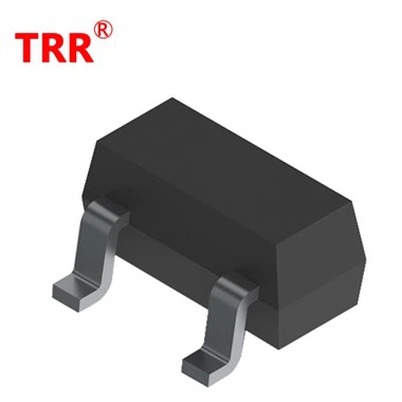
Does the forward voltage drop of diodes in wearable medical devices affect battery life?
Leave a message
1, The technical essence and energy loss mechanism of forward pressure drop
The forward voltage drop (Vf) of a diode is the voltage loss caused by carrier recombination and resistance effects when current passes through a PN junction. According to different material types, their typical values vary significantly: silicon diodes have a voltage range of 0.6V~0.7V, Schottky diodes have a voltage range of 0.2V~0.4V, while light-emitting diodes (LEDs) have a voltage range of up to 1.8V~3.6V. This difference is due to the bandgap width of semiconductor materials and device structure design - for example, Schottky diodes replace traditional PN junctions with metal semiconductor contacts, significantly reducing the energy required for carrier recombination.
In wearable devices, even small differences in pressure drop can accumulate significant losses due to continuous operation. For example, the heart rate monitoring module of a smart bracelet uses a silicon diode (Vf=0.7V), and when the working current is 10mA, the daily power consumption is:
0.7V×10mA×24h=1.68Wh
If a Schottky diode (Vf=0.3V) is used instead, the power consumption can be reduced to 0.72Wh and the battery life can be extended by nearly 2.3 times.
2, Key application scenarios of forward pressure drop in wearable medical devices
1. Heart rate monitoring and photoplethysmography (PPG)
Smart wristbands use PPG technology to monitor heart rate, with the core being LED emitting green light (wavelength 530nm) that penetrates the skin, and photodiodes receiving reflected light signals. During this process, the forward voltage drop of the LED directly affects the luminous efficiency:
Traditional silicon diode driven LED: If Vf=3.2V (typical value for white LED), it needs to work through a boost circuit in a 3.3V power supply system, resulting in an additional energy loss of about 10%.
Schottky diode driven LED: Vf can be as low as 2.0V (red LED), directly matched with lithium battery discharge platform (3.0V~4.2V), without the need for boost circuit, system efficiency is improved by more than 15%.
2. Wireless data transmission for continuous blood glucose monitoring (CGM)
CGM devices need to upload real-time blood glucose data through low-power Bluetooth (BLE). In their RF front-end circuits, Schottky diodes are commonly used in mixers and detectors to rectify high-frequency signals. For example, a certain CGM device uses BAT62-02V Schottky diode (Vf)= 0.25V@10mA )In the 2.4GHz frequency band, the conduction loss is reduced by 60% compared to silicon diodes, extending the single charge range from 7 days to 11 days.
3. Anti reverse design of battery protection circuit
Wearable devices require diodes to prevent battery reverse connection from causing circuit damage. The traditional solution uses silicon diodes, but a voltage drop of 0.7V will significantly reduce the system voltage margin. For example, when a certain smartwatch is connected to a 5V USB input, if a silicon diode anti reverse connection is used, the actual voltage reaching the charging chip is only 4.3V, which is close to the termination voltage of lithium battery charging (4.2V), and is prone to triggering undervoltage protection. After switching to Schottky diodes, the input voltage margin increased to 4.7V, significantly improving charging stability.
3, Optimization strategies and technological trends for forward pressure drop
1. Device selection: innovation from materials to structures
Schottky diode: With its low Vf (0.2V~0.4V) and high switching speed (nanosecond level), it has become the preferred choice for high-frequency and low-power scenarios. For example, ROHM's SBT40100VDC Schottky diode has a Vf of only 0.54V at 40A current and maintains 0.48V even at a temperature rise of 125 ℃, making it suitable for high current charging circuits.
Synchronous rectification technology: Using MOSFETs instead of diodes to achieve the "virtual diode" function, the conduction voltage drop can be as low as 20mV or less. For example, TI's CSD88539 synchronous rectification controller consumes only 20mW of power at 1A current, which is 90% lower than Schottky diodes.
Wide bandgap materials: Silicon carbide (SiC) and gallium nitride (GaN) diodes have lower on resistance and higher withstand voltage, making them suitable for high power density scenarios. For example, Wolfspeed's C3D10060A SiC Schottky diode has a Vf of only 1.7V at 600V withstand voltage, which is 5% more efficient than silicon devices.
2. Circuit Design: Topology Optimization and Energy Recovery
Charge pump circuit: voltage conversion is achieved through capacitor energy storage to avoid diode voltage drop losses. For example, a certain smart bracelet uses the LTC3588 charge pump chip to directly boost the weak current (μ A level) output by the photodiode to 3.3V, with an efficiency of 85%.
Dynamic Voltage Adjustment (DVS): Real time adjustment of power supply voltage based on load demand, reducing the proportion of diode voltage drop. For example, the Apple Watch Series 7 reduces the power supply voltage from 3.3V to 2.8V in heart rate monitoring mode, resulting in a 15% decrease in Schottky diode power consumption.
Energy recovery technology: utilizing the transient energy generated by the conduction of diodes to charge supercapacitors. For example, a certain implantable medical device extends standby time by 30% by recovering the voltage drop energy of diodes in the electrocardiogram signal acquisition circuit.
3. System integration: from discrete components to single-chip solutions
Integration trend: Integrating diodes with MCU and sensors on the same chip to reduce parasitic parameters and wiring losses. For example, ADI's MAX30102 photoelectric sensor integrates a low Vf photodiode and LED driver circuit, with a Vf of only 0.3V at a current of 0.1mA, reducing power consumption by 40% compared to discrete solutions.
Algorithm compensation: correcting the impact of diode voltage drop on the signal through software. For example, the Huawei GT series wristbands introduce a temperature compensation algorithm in PPG signal processing to dynamically adjust the LED driving current and offset the error of Vf changing with temperature (about -2mV/℃).