


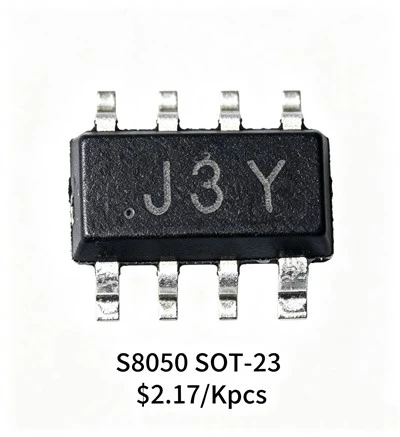
A transistor is a semiconductor device used to amplify or switch electrical signals and power. It is one of the basic building blocks of modern electronics. It is composed of semiconductor material, usually with at least three terminals for connection to an electronic circuit. A voltage or current applied to one pair of the transistor's terminals controls the current through another pair of terminals. Because the controlled (output) power can be higher than the controlling (input) power, a transistor can amplify a signal. Some transistors are packaged individually, but many more in miniature form are found embedded in integrated circuits.


Advantages of Transistor
Low Power Consumption
Transistors require less power than vacuum tubes, making them ideal for battery-powered devices like mobile phones.
Small Size
Transistors are much smaller than vacuum tubes, making them ideal for miniaturizing electronic circuits. This size reduction has led to the development of portable electronic devices like laptops and smartphones.
High Reliability
Transistors are more reliable than vacuum tubes because they have no filament that can burn out. This makes transistors ideal for use in critical applications like medical equipment and aerospace technology.
Fast Switching Speeds
Transistors can switch on and off much faster than vacuum tubes. This makes them ideal for use in digital circuits like microprocessors and memory chips.
Why Choose Us
Company Honor
The company has obtained more than 80 patent authorizations, covering aspects such as invention patents, design patents, and utility model patents.
Corporate Strategy
Expand more market shares in oversea market shares, then estabilish new company for passive components,improving prefer supply chain system, provide more best service to customer.
Products Applications
Products widely applied in many areas such as power supply and adapters (customer: SUNGROW power supply), green lighting (customers: MLS, TOSPO lighting), router (customer: Huawei), smart phone (customers: Huawei, Xiaomi, OPPO) and communication products, automobile electrics (customer: SAIC General Motors), frequency transformer, big and small household electrical appliances (customer: Gree), safety guard area (HIKVISION, DAHUA) and other areas.
R&D Capability
According to the actual management requirements, the company has independently built a TRR office management system for many years, incorporating most functions such as production, sales, finance, personnel, and administration into the system management, promoting the company's management informationization, and realizing the production and demand database management mode , Improve the quality and efficiency of production and management, better achieve the management of complex products, complex production, and meet the different needs of customers.
A transistor can act as a switch or gate for electronic signals, opening and closing an electronic gate many times per second. It ensures the circuit is on if the current is flowing and switched off if it isn't. Transistors are used in complex switching circuits that comprise all modern telecommunications systems. Circuits also offer very high switching speeds, such as hundreds of gigahertz or more than 100 billion on-and-off cycles per second.
Transistors can be combined to form a logic gate, which compares multiple input currents to provide a different output. Computers with logic gates can make simple decisions using Boolean algebra. These techniques are the foundation of modern-day computing and computer programs.
Transistors also play an important role in amplifying electronic signals. For example, in radio applications, like FM receivers, where the received electrical signal may be weak due to disturbances, amplification is required to provide audible output. Transistors provide this amplification by increasing the signal strength.

Transistor Operation Modes
When a small signal is applied between one pair of terminals in a transistor, a signal can be operated to control a much larger signal at another pair of terminals. In this part, the property of the transistor is gained due to signal strength in the process of switching and the output generated can be either voltage or current or electronic signal. If the input increases then the output also increases. In other words, it is simple to say that output is proportional to input. Due to this particular activity transistor can act as an amplifier.
The main use of a transistor is that it makes the circuit more controllable and the current flow is determined by other circuit elements. Depending on the biasing conditions like forward or reverse, transistors have three major modes of operations cutoff, active, and saturation regions.
Active Mode: In this mode, the transistor is generally used as current amplifier. In active mode, two junctions are differently biased which means emitter-base junction is forward biased whereas collector-base junction is reverse biased. In this mode, current flows between emitter and collector and the amount of current flow in proportional to the base current.
Cutoff Mode: Here both collector base junction and emitter junction are reverse biased. As both the PN junction are reverse biased, there is almost no current flow except very small leakage of currents. In BJT mode it is switched OFF and is essentially an open circuit. This region is mainly used in switching and digital logic circuits.
Saturation Mode: In this particular mode of operation, both the emitter-base and collector-base junctions are forward biased. Here current flows freely from collector to emitter with almost 0 resistance. In this mode, the transistor is fully switched ON and it is a closed circuit. It is mainly used in switching and digital logic circuits.
Transistor Materials and Manufacturing Process
The materials used to produce transistors and their manufacturing process are critical to their performance and functionality. Silicon, a semiconductor, is the most commonly used material in transistor production due to its excellent semiconductor properties, abundance, and relatively low cost. It has a crystalline structure that allows the controlled introduction of impurities, a process known as doping, which is crucial for the operation of transistors.
Doping involves introducing impurities into the silicon to change its conductivity. There are two types of doping: n-type, where the dopant atoms have more valence electrons than silicon, and p-type, where the dopant atoms have fewer valence electrons. The interaction between n-type and p-type materials in a transistor allows the control and amplification of electrical signals.
The manufacturing process of transistors is complex and involves several steps. The process begins with creating a silicon wafer, a thin slice of silicon crystal. Then, the wafer is subjected to various processes, including oxidation, photolithography, etching, and diffusion or ion implantation, to create the transistor's structure. Oxidation involves growing a silicon dioxide layer on the wafer, which acts as an insulator. Photolithography is used to transfer the transistor's pattern onto the wafer, etching removes unwanted material to reveal the transistor's structure, and diffusion or ion implantation introduces the dopants into the silicon.
The final steps involve depositing metal contacts to connect the transistor to the rest of the circuit and packaging the finished transistor for electronic devices. The entire process is carried out in a cleanroom environment to prevent contamination, which could negatively affect the transistor's performance.
The manufacturing process of transistors has evolved significantly thanks to technological advances, enabling the production of increasingly smaller and more powerful transistors. Today, transistors are manufactured using advanced techniques such as FinFET (Fin Field-Effect Transistor) and GAAFET (Gate-All-Around Field-Effect Transistor) technology, which allow for the production of transistors with features as small as a few nanometers.
These advances in materials and manufacturing processes have been key to the ongoing evolution of transistor technology, enabling the development of increasingly powerful and energy-efficient electronic devices.
Bipolar Junction Transistor (BJT)
Bipolar Junction Transistors are transistors that are built up of 3 regions, the base, the collector, and the emitter. Bipolar Junction transistors, different FET transistors, are current-controlled devices. A small current entering the base region of the transistor causes a much larger current flow from the emitter to the collector region. Bipolar junction transistors come in two major types, NPN and PNP. An NPN transistor is one in which the majority of the current carriers are electrons.
Electron flowing from the emitter to the collector forms the base of the majority of current flow through the transistor. The further types of charge, holes, are a minority. PNP transistors are the opposite. In PNP transistors, the majority of current carrier holes. BJT transistors are available in two types namely PNP and NPN.
PNP Transistor
This transistor is another kind of BJT – Bipolar Junction Transistors and it contains two p-type semiconductor materials. These materials are divided through a thin n-type semiconductor layer. In these transistors, the majority charge carriers are holes whereas the minority charge carriers are electrons.
In this transistor, the arrow symbol indicates the conventional current flow. The direction of current flow in this transistor is from the emitter terminal to the collector terminal. This transistor will be turned ON once the base terminal is dragged to LOW as compared with the emitter terminal. The PNP transistor with a symbol is shown below.
NPN Transistor
NPN is also one kind of BJT (Bipolar Junction Transistors) and it includes two n-type semiconductor materials which are divided through a thin p-type semiconductor layer. IN the NPN transistor, the majority charge carriers are electrons whereas the minority charge carriers are holes. The electrons flow from the emitter terminal to the collector terminal will form the current flow within the base terminal of the transistor.
In the transistor, the less amount of current supply at the base terminal can cause supply huge amount of current from the emitter terminal to the collector. At present, the commonly used BJTs are NPN transistors, as the electrons mobility is higher as compared with the mobility of holes. The NPN transistor with a symbol is shown below.
Field Effect Transistor
Field Effect Transistors are made up of 3 regions, a gate, a source, and a drain. Different bipolar transistors, FETs are voltage-controlled devices. A voltage placed at the gate controls current flow from the source to the drain of the transistor. Field Effect transistors have a very high input impedance, from several mega ohms (MΩ) of resistance to much, much larger values.
This high input impedance causes them to have very little current run through them. (According to ohm's law, the current is inversely affected by the value of the impedance of the circuit. If the impedance is high, the current is very low.) So FETs both draw very little current from a circuit's power source.
Thus, this is ideal because they don't disturb the original circuit power elements to which they are connected to. They won't cause the power source to be loaded down. The drawback of FETs is that they won't provide the same amplification that could be gotten from bipolar transistors.
Bipolar transistors are superior in the fact that they provide greater amplification, even though FETs are better in that they cause less loading, are cheaper, and easier to manufacture. Field Effect Transistors come in 2 main types: JFETs and MOSFETs. JFETs and MOSFETs are very similar but MOSFETs have even higher input impedance values than JFETs. This causes even less loading in a circuit. FET transistors are classified into two types namely JFET and MOSFET.
JFET
The JFET stands for Junction-Field-Effect transistor. This is simple as well as an initial type of FET transistors which are utilized like resistors, amplifiers, switches, etc. This is a voltage-controlled device and it doesn't use any biasing current. Once the voltage is applied among gate & source terminals then it controls the current flow among the source & drain of the JFET transistor.
The Junction Field Effect Transistor (JUGFET or JFET) has no PN-junctions but in its place has a narrow part of high resistivity semiconductor material forming a “Channel” of either N-type or P-type silicon for the majority carriers to flow through with two ohmic electrical connections at either end normally called the Drain and the Source respectively.
There are two basic configurations of a junction field-effect transistor, the N-channel JFET and the P-channel JFET. The N-channel JFET's channel is doped with donor impurities meaning that the flow of current through the channel is negative (hence the term N-channel) in the form of electrons. These transistors are accessible in both P-channel and N-channel types.
MOSFET
MOSFET or Metal-Oxide-Semiconductor Field-Effect Transistor is most frequently used among all kinds of transistors. As the name suggests, it includes the terminal of the metal gate. This transistor includes four terminals like source, drain, gate & substrate, or body.
As compared with BJT and JFET, MOSFETs has several benefits as it provides high i/p impedance as well as low o/p impedance. MOSFETs are mainly used in low power circuits especially while designing chips. These transistors are available in two types like depletion & enhancement. Further, these types are categorized into P-channel & N-channel types.
How to Select a Transistor
Collector Current
From the transistor datasheet, look for the collector current rating (IC). The maximum limit is 2A. Thus, in your design, do not exceed the actual collector current higher to this level. Set the actual collector current to only 50% of the maximum rating and your design will be fine. You can set to higher than 50% actually but be careful and ensure your actual current calculation is accurate enough.
Peak Pulse Collector Current (ICM)
This rating is important when the transistor is used in application in which the collector current is not straight or pure DC, for example, in switching converter, PSU and inverters.
Collector-Emitter Voltage (VCEO)
The first two important ratings above on how to select a transistor are both current. Another equally important rating is the Collector-Emitter Voltage. Actually, this is the voltage seen by the transistor when the base is open. To measure this, simply get a volt meter. Put the positive probe to the collector while the negative probe to the emitter.
Emitter-Base Voltage (VEBO)
This is the voltage across the emitter to base junction while the collector is open. The base-emitter of a transistor is basically a diode. In other words, the emitter-base voltage is the maximum reverse voltage that can be applied across to this diode.
Collector-Base Voltage (VCBO)
This is the voltage across the collector to base junction when the emitter is open. The base-collector of a transistor is a diode. So, the collector-base voltage is the maximum reverse voltage that can be applied across to this diode. Take note not to exceed this value. Otherwise, the transistor will get damage right away.
Saturation Voltage
Another parameter that is important is the saturation voltage. The collector – emitter saturation voltage is needed in order to compute the actual power dissipation of transistor. The ideal case is that this power dissipation is low. In order to attain it, the collector – emitter saturation voltage must be very low.
Power Dissipation
The next very important rating of a transistor is the power dissipation. It is given in the datasheet like below.
Thermal Resistance
When the transistor is use to operate at temperature more than the typical value, thermal resistance is needed to get the maximum power rating of the transistor. This is also called the de-rated power. Thermal resistance is could be defined as junction to ambient or junction to case.
Applications of Transistor
Switch: Transistors can function like electronic switches. By applying a small voltage, a large current flow can be controlled on or off. This capability is crucial for digital circuits, the foundation of modern computers and many other devices.
Amplifier: Transistors can take a weak electrical signal and make it much stronger. This is essential for applications such as hearing aids, amplifiers for musical instruments, and radio technology.
Integrated Circuits (ICs): Transistors are miniaturized and embedded in large numbers onto tiny silicon chips to create complex integrated circuits. These ICs are the heart of modern electronics, found in everything from smartphones and computers to cars and medical devices.
Memory: Transistors are used in various memory devices, such as Random Access Memory (RAM) and Flash memory, which enable electronic devices to store and retrieve data.
Logic Gates: Transistors can be combined to form logic gates, the basic building blocks of digital circuits. Logic gates perform basic operations like AND, OR, and NOT, which allows for complex computations within electronic devices.
FAQ
We're well-known as one of the leading transistor manufacturers and suppliers in China. If you're going to buy high quality transistor in stock, welcome to get quotation from our factory. Also, OEM service is available.