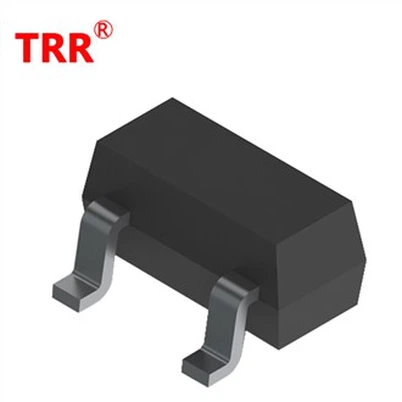
Application of diodes in wireless charging of mobile phones
Leave a message
1, The basic principle of wireless charging for mobile phones
Wireless charging of mobile phones is mainly based on the principle of electromagnetic induction. When the charger (transmitter) is powered on, it will generate an alternating magnetic field. The wireless charging receiving coil (receiving end) on the back of the phone will generate induced current under the action of an alternating magnetic field, which will then charge the phone battery. This charging method does not require physical connection, simply place the phone on or near the charger to achieve power transmission.
2, Basic characteristics and functions of diodes
A diode is an electronic component with unidirectional conductivity, composed of a PN structure formed by a P-type semiconductor and an N-type semiconductor. When a voltage higher than the negative electrode (cathode) is applied to the positive electrode (anode) of a diode, the diode conducts and current can flow from the positive electrode to the negative electrode; When the positive voltage of the diode is lower than the negative voltage, the diode cuts off and the current hardly flows. This unidirectional conductivity enables diodes to perform various functions in circuits, such as rectification, voltage regulation, and switching.
3, Application of diodes in wireless charging of mobile phones
In the wireless charging system of mobile phones, the application of diodes is mainly reflected in the following aspects:
Rectification effect
The induced current generated by the wireless charging receiving coil is AC power, while the mobile phone battery requires DC power. Therefore, in wireless charging systems, it is necessary to convert alternating current into direct current through rectifier circuits. As one of the core components of rectifier circuits, diodes can cut off the negative half cycle of AC power and only allow the positive half cycle to pass through, thereby achieving rectification function. Through rectification circuits, wireless charging systems can provide stable DC charging current for mobile phone batteries.
Voltage stabilizing effect
During the wireless charging process of mobile phones, various factors such as the distance between the charger and the phone, the position of the receiving coil, etc. can cause fluctuations in the charging voltage. In order to maintain stable charging voltage, wireless charging systems need to use voltage stabilization circuits. As one of the important components of a voltage regulator circuit, diodes can stabilize the output voltage within a certain range through their reverse breakdown characteristics or series stabilization characteristics. In this way, even if the charging voltage fluctuates, it can ensure that the mobile phone battery receives a stable charging voltage, thereby protecting the battery from damage.
Function of switch
In the wireless charging system of mobile phones, diodes can also be used as switching elements to control the on/off of current. When the wireless charging system detects that the phone is placed on the charger, it will trigger the switch diode to conduct, allowing charging current to pass through; When the phone is removed from the charger, the switch diode will cut off, cutting off the charging current. This switch function not only improves the efficiency and safety of wireless charging systems, but also prevents problems such as excessive current or short circuits caused by misoperation or abnormal situations.
protection circuit
In the wireless charging system of mobile phones, diodes can also be combined with other components to form a protective circuit, which is used to prevent damage to the circuit and components caused by abnormal situations such as overcurrent and overvoltage. For example, when the charging current is too high, a current limiting resistor and a diode can be connected in series to limit the magnitude of the current; When the charging voltage is too high, a voltage regulator diode can be connected in parallel to stabilize the voltage within a certain range. These protective circuits can ensure that the wireless charging system operates within its normal operating range, improving the reliability and safety of the system.
4, Diode selection and optimization design
The selection and optimization design of diodes are crucial for improving the performance and stability of mobile wireless charging systems. On the one hand, it is necessary to select diodes with appropriate breakdown voltage, reverse leakage current, and forward conduction voltage drop characteristics to ensure their normal operation in wireless charging systems. On the other hand, it is also necessary to optimize the design of diodes, such as adopting low-power, high reliability packaging forms, improving the heat dissipation performance of diodes, etc., in order to further improve the efficiency and safety of wireless charging systems.
https://www.trrsemicon.com/diode/smd-diode/schottky-diode-b0520w.html