


We are an enterprise whose main business is the research and development, production and sales of semiconductor discrete components and products. Our company has core technologies in many fields such as wafers, packaging, device testing, and application design. We are committed to the research and development, production, sales, and application solution design of new components, and have obtained more than 80 national authorized invention patents.
Technical Excellence
Our company ensures superior product quality by leveraging cutting-edge technology in wafer manufacturing, packaging, and testing, providing clients with reliable and high-performance electronic components.
OEM/ODM Services
Leverage our OEM/ODM prowess to bring your product vision to life. With custom designs and high-quality manufacturing, we deliver solutions that perfectly align with your brand and market needs, ensuring a competitive edge in a rapidly evolving marketplace.
Leading Service
We have many years of industry experience and a complete production management, quality supervision, sales service operation system. Whether you want to buy transistors or diodes, just send your requirements by email and we can customize the product for you.
Quality Guaranteed
Our products have obtained ISO-14000; ISO-9001 IATF-16949 and other certificates, and have obtained more than 80 national invention patents, including the MB10F bridge stack commonly used in the power supply industry, the UMB10F/B7 bridge stack used in the LED industry, the world's smallest bridge stack IBS and a series of high junction temperature products.
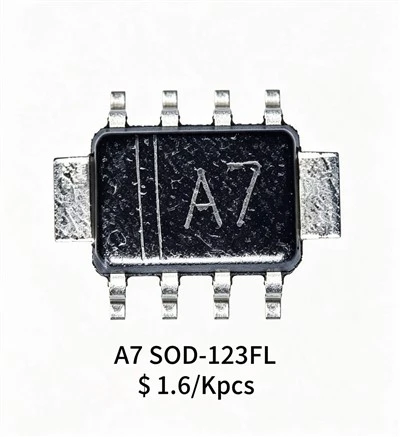


A surface-mounted diode is a type of semiconductor component that is mounted directly onto the surface of a printed circuit board (PCB) without using traditional through-holes for component leads. In surface-mount technology, or SMT, components like diodes are designed to be soldered onto pads on the PCB's surface, which allows for a more compact and lightweight assembly.
Features of SMD diodes
Size and Weight
Surface-mounted diodes are much smaller and lighter than through-hole diodes. This also makes it easier to pick up and place.
Increased Speed
The shorter leads and smaller overall size of surface-mounted diodes can reduce parasitic capacitance and inductance, leading to faster switching times and improved performance at high frequencies.
Automated Assembly
It has simpler and faster automated assembly.This reduces labor costs and the potential for human error during manufacturing.
Better Performance
Being able to have electrical components glued to a printed circuit board isn’t good enough. This is because such can fall off especially due to vibration or shaking. When this happens, the electrical device or appliance is likely to get damaged. This is where SMT can prove to be very useful. It tends to provide stability that will enable electrical components withstand the harshest and most unfavorable conditions. In the case of vibrations, they have proven to be the best option amongst others. In a nutshell, they are more stable.
Higher Packing Density
The use of surface-mount technology enables higher packing densities on printed circuit boards, as components can be placed closer together and do not require the space-consuming through-holes of traditional parts. This design advantage supports the increasing complexity and functionality demands of modern electronics.
Improved Reliability
Surface-mounted diodes benefit from a construction that eliminates the mechanical weaknesses associated with holes and leads. With no lead stresses to contend with, these devices are less vulnerable to failures caused by shock and vibration, resulting in a more reliable product for various applications.
Heat Dissipation
Certain surface-mount packages like PowerPad or Flat No-leads (DFN, QFN) are designed with larger thermal pads that improve heat dissipation, making them suitable for higher power applications.
Cost-Effectiveness
Although the initial setup costs for surface-mount production lines can be high, the high-volume production and reduced labor costs can make surface-mounted diodes more cost-effective in the long run.
Design Flexibility
This is another advantage that surface mount technology can offer manufacturers. With its usage, there is the possibility of being able to use through-hole on the same board. There is no need to worry since this can ensure better functionality. It is also crucial to point out that SMT makes it possible for multitasking to take place. This is because there is the versatility of high-end components.
Types of SMD diodes
SMD diodes come in several types, each with its unique characteristics and applications.
Rectifier diode
One common type is the rectifier diode, which converts alternating current (AC) to direct current (DC) in power supplies. Rectifier diodes have a high current handling capability and can withstand high reverse voltages.
Schottky diode
Another type of SMD diode is the Schottky diode, known for its low forward voltage drop and fast switching speed. Schottky diodes are used in high-frequency applications, such as radio frequency (RF) circuits and switching power supplies.
Zener diodes
Zener diodes are another type of SMD diode, used for voltage regulation. They have a specific voltage limit beyond which they begin to conduct in the reverse direction. This property allows them to maintain a constant voltage across their terminals, making them useful for voltage regulation in electronic circuits.
Light-emitting diodes
Light-emitting diodes (LEDs) are a particular type of diode that emits light when a current flows through them. SMD LEDs are used in a wide range of applications, from indicator lights to display panels.
Triode
A triode is a vacuum tube consisting of three electrodes: a heated filament or cathode, a grid, and a plate (anode). SMD triodes are used in a wide variety of electronic devices, and they offer a number of advantages over traditional through-hole triodes.
Applications of SMD diodes
Automotive Application
In the automotive industry, SMD diodes play a crucial role in lighting systems, voltage stabilization, and signal processing. They are integral to the operation of advanced electronics within vehicles, ensuring reliable performance under various conditions.
01
Consumer Electronics
SMD diodes are widely used in consumer electronics, including smartphones, televisions, and gaming consoles. These tiny components enable efficient signal transmission and power management, enhancing the overall functionality of these devices.
02
Communications and Computing
Within the realm of communications and computing, SMD diodes are essential for signal transmission and processing. They facilitate data transfer and logic functions in computers, routers, and other networking equipment, contributing to faster and more reliable connectivity.
03
Industrial Uses
In the industrial sector, SMD diodes are employed in automation and control systems. They help regulate power and manage signals in machinery, contributing to smooth operation and precise control in manufacturing processes.
04
Other Applications
Beyond these main industries, SMD diodes also find use in various other applications, such as medical equipment, aerospace technology, and defense systems. Their compact size and reliability make them ideal for use in high-tech environments where space is limited and performance demands are high.
05
How to pick the right SMD diodes for your business
Package Size
SMD diodes come in various package sizes, such as 0201, 0402, 0603, 0805, and 1206. The package size determines the physical dimensions of the diode, which can affect factors like power handling, current capacity, and board space requirements.
Voltage Rating
SMD diodes have different voltage ratings, ranging from low-voltage (e.g., 30V) to high-voltage (e.g., 1000V) variants. Ensure the voltage rating of the diode you select is suitable for your application.
Current Rating
The current rating of an SMD diode indicates the maximum forward current it can handle without being damaged. This is an important consideration, as exceeding the current rating can lead to overheating and failure.
Polarity
SMD diodes have a positive (anode) and negative (cathode) terminal, just like through-hole diodes. Ensure you install the diode with the correct polarity to avoid damage.
Reverse Recovery Time
This parameter, measured in nanoseconds (ns), describes how quickly the diode can switch from forward to reverse bias. Faster reverse recovery times are generally desirable for high-frequency applications.
Leakage Current
The leakage current of a diode is the small amount of current that flows in the reverse direction when the diode is reverse-biased. Lower leakage current is often preferred for sensitive applications.
Power Dissipation
The power dissipation rating of an SMD diode indicates the maximum power it can safely handle without exceeding its temperature limits. Choose a diode with a power dissipation rating appropriate for your usage conditions.
Thermal Characteristics
Consider the thermal resistance (junction-to-ambient) and junction temperature of the SMD diode, as these can impact the diode's reliability and performance in your specific application.
Working principle of SMD diodes
During the initial formation of semiconductors, pure materials such as silicon and germanium are used, with a price of four. At this stage, the material is considered electrically neutral due to the equal number of electrons and holes, exhibiting poor conductivity. To solve this problem, trivalent elements such as boron and pentavalent elements such as phosphorus or arsenic are introduced to replace some silicon or germanium atoms.
Boron introduces holes, while phosphorus or arsenic introduces free electrons, forming P and N regions. At this time, the concentration of holes in the P region is higher than that in the N region, and conversely, the concentration of electrons in the N region is higher than that in the P region. Due to the concentration difference, the high-concentration region diffuses to the low-concentration region, causing the holes in the P region to move to the N region and the electrons in the N region to move to the P region. In this process, the holes and electrons meet and recombine.
When a positive voltage is applied to the anode (the pin with stripes on the diode) and a negative voltage is applied to the cathode, the diode is said to be forward biased. If the voltage polarity is reversed, that is, a negative voltage is applied to the anode and a positive voltage is applied to the cathode, the diode is in a reverse biased state. Conduction and Blocking SMD diodes conduct when forward biased and block when reverse biased.

Identification of positive and negative electrodes
The identification of the positive and negative poles of an SMD diode can be observed by the casing. When the mark on the casing is severely worn out, we can use a multimeter for identification. Set the multimeter to the gear of “R × 100 Ω” or “R × 1 kΩ”. First use the red and black test leads of the multimeter to randomly measure the resistance between the two pins of the SMD diode, and then exchange the two test leads for another measurement. In the two measurement results, the one with the smaller resistance value indicates that the SMD diode has a forward resistance (generally several hundred to several thousand ohms), with the black test lead connected to the positive pole and the red test lead connected to the negative pole. While the other result with a larger resistance shows that the SMD diode has a reverse resistance (generally several tens of kilohms to several hundred kilohms), with an opposite connection of the test leads to the first one.
Judging the Performance
The detection of the performance of SMD Diodes is usually carried out in an open state (away from the circuit board).Use the “R × 100Ω” or “R × 1 kΩ” gear of the multimeter to measure the forward and reverse resistance of the SMD diode. According to the unidirectional conductivity of the diode, the greater the difference between the forward and reverse resistances, the better the unidirectional conductivity will be. If there is little difference between forward and reverse resistances, it means the performance of unidirectional conductivity of the SMD diode is deteriorated; if the positive and negative resistances are both large, the SMD diode has an open circuit failure; if the positive and negative resistances are small, the patch diode has failed. When the above three conditions occur in the SMD diode, it must be replaced.
Main materials of SMD diodes
The main materials of SMD diodes consist of semiconductor chips, metal connections (such as gold or aluminum wires), and packaging substrates.
Semiconductor Chip
The semiconductor material is typically silicon, which can be doped with other elements like phosphorus or boron to create the required P-N junction for the diode to function.
Metal connection
Metal connections are used to form electrical pathways within the device, with gold wires offering excellent electrical conductivity and corrosion resistance, while aluminum wires are more cost-effective despite lower conductivity.
Package substrate
Packaging substrates are usually ceramic or plastic materials, providing both physical support and thermal management for the diode. Additionally, encapsulants like epoxy or silicone resin protect the internal components from environmental factors and mechanical damage.
Certificate


Frequently Asked Questions
We're well-known as one of the leading smd diode manufacturers and suppliers in China. If you're going to buy high quality smd diode in stock, welcome to get quotation from our factory. Also, OEM service is available.
DIODE FR101 FR107, Diode M7, M7 DO-214AC