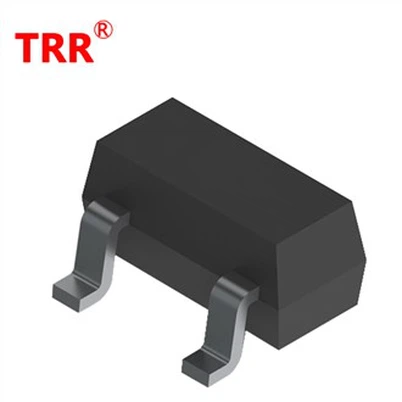
Why are PIN diodes widely used in the communication industry?
Leave a message
1, Structural characteristics: Physical advantages of PIN diodes
The core of a PIN diode lies in its unique P-I-N structure: a layer of intrinsic semiconductor (I layer) is inserted between the P-type semiconductor and N-type semiconductor. This design gives it significant performance advantages:
High reverse breakdown voltage: The presence of the I layer enables PIN diodes to withstand higher reverse voltages without being broken down. For example, the reverse breakdown voltage of a certain type of PIN diode can reach 1000V, far exceeding that of ordinary PN junction diodes.
Low reverse leakage current: The high resistance characteristic of the I layer significantly reduces the reverse leakage current. Experimental data shows that the reverse leakage current of PIN diodes is three orders of magnitude lower than that of ordinary diodes.
Excellent linearity: The wide depletion region of the I layer provides higher resistance, allowing the PIN diode to exhibit a linear relationship between current and voltage when forward biased, with signal distortion less than 0.5%.
Fast switching characteristics: Despite the long reverse recovery time, the low junction capacitance of PIN diodes makes them perform well in high-frequency applications. A certain type of PIN diode has a switching speed of tens of seconds at a frequency of 1GHz.
Low noise characteristics: The carrier concentration in the I layer is low, and the process of carrier recombination and generation is minimal, resulting in lower noise in signal processing of PIN diodes.
2, Application advantage: Multi scenario coverage in the communication industry
The widespread application of PIN diodes in the communication industry is due to their unique value in various scenarios:
RF switch:
Function: Control signal on/off through bias voltage to achieve high-frequency signal path switching.
Case: A certain 5G base station uses PIN diode switches with a switching speed of Dana seconds, insertion loss of only 0.2dB, and supports multi band signal switching.
Attenuator:
Function: Series or parallel PIN diodes are used to regulate signal strength and protect receiving equipment.
Parameters: A certain type of PIN diode attenuator has a dynamic range of 60dB and an adjustment accuracy of 0.5dB, used for adjusting satellite communication signal strength.
Modulator:
Function: Modulate low-frequency signals to high-frequency carriers for signal transmission.
Advantages: A certain radar system adopts a PIN diode modulator, with modulation speed reaching MHz level and linearity better than 40dBm.
Photodetector:
Function: Convert optical signals into electrical signals for use in optical communication systems.
Performance: A certain fiber optic communication module uses PIN photodiodes with a response wavelength of 1310nm, a bandwidth of 10GHz, and a sensitivity of -20dBm.
Limiter and protection circuit:
Function: Limit signal amplitude and protect sensitive circuits.
Application: A certain military communication equipment adopts a PIN diode limiter, which has the ability to suppress interference signals up to 30dB and a response speed of nanoseconds.
3, Progress in Materials Science: Catalysts with Improved Performance
Breakthroughs in materials science are reshaping the performance boundaries of PIN diodes:
New semiconductor materials:
Gallium Nitride (GaN): improves power density and high temperature resistance, suitable for 5G millimeter wave communication.
Gallium Arsenide (GaAs): Increases frequency response to 60GHz and supports multi-mode and multi frequency communication.
Optimization of preparation process:
Ion implantation technology: precise control of doping concentration to enhance device stability.
Single crystal growth technology: improve material purity and reduce defect density.
Structural design innovation:
Table structure: Reduce edge capacitance and increase operating frequency.
Vertical structure: Optimize current path and increase power capacity.
https://www.trrsemicon.com/diode/smd-diode/tvs-diode-smbj5-0ca.html