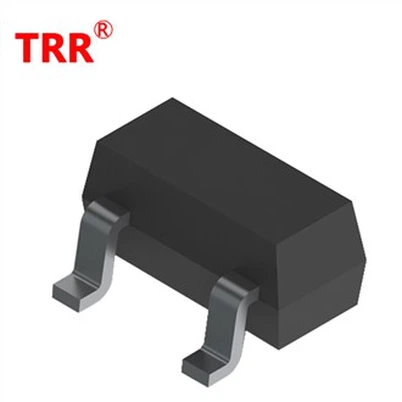
What type of diode is used in the solar charging controller?
Leave a message
一, Anti reverse charging diode: a "safety valve" that blocks reverse current
1. Core functions and failure risks
Blocking diode is a "one-way valve" for independent photovoltaic systems, whose core functions include:
Nighttime backflow prevention: When the solar panel has no light, if its voltage is lower than the battery voltage, the current will flow back into the solar panel from the battery, causing the components to heat up or even burn out.
Branch anti backflow: In a series connected photovoltaic array, if a branch voltage drops due to shadows or faults, the current of the high-voltage branch will flow back to the low-voltage branch, causing a decrease in the overall output voltage.
2. Limitations of traditional silicon diodes
Traditional photovoltaic controllers often use silicon rectifier diodes such as 1N4007 and 1N5408, with typical parameters being:
Positive voltage drop: 0.6-0.8V (high-power tubes can reach 1-2V)
Voltage withstand capacity: The reverse peak voltage should be at least twice the maximum voltage of the system
Power loss: Taking 10A current as an example, the annual power loss of a single tube is 5256Wh (calculated based on 5 hours of sunshine per day and 365 days)
3. Alternative advantages of Schottky diodes
Schottky diodes (such as SB5100, 1N5817) are designed with a metal semiconductor junction to reduce the forward voltage drop to 0.1-0.3V while maintaining fast switching characteristics (nanosecond response). Taking a 100kW photovoltaic power station as an example:
Efficiency improvement: After adopting Schottky diodes, the overall efficiency of the controller increased by 1.2%
Temperature rise control: Reduce junction temperature by 15 ℃ and extend the lifespan of components inside the junction box by 30%
Cost balance: Although the unit price is 2-3 times that of silicon diodes, the comprehensive cost is reduced by 18% within a 5-year cycle due to voltage reduction and low losses
4. Selection principles in industry practice
Low voltage system: 1N5817 (20V/3A) or SS34 (40V/3A) is preferred for 12V/24V systems
High voltage system: SiC Schottky diodes (such as C3D10060A, 600V/10A) are used for arrays above 600V, with a reverse recovery time of<10ns, suitable for high-frequency switching scenarios
Integration trend: Modern MPPT controllers integrate anti reverse charging function into MOSFET driver circuits, achieving lossless anti reverse charging through synchronous rectification technology, and improving efficiency by more than 3% compared to diode solutions
二, Synchronous rectifier diode: the "efficiency engine" of DC-DC conversion
1. The core challenge of MPPT controller
The MPPT controller adjusts the output voltage/current of the solar panel through a DC-DC converter to always operate at the maximum power point (MPP). The traditional approach uses silicon diodes for rectification, but there are two major pain points:
Conduction loss: The 0.7V voltage drop of the silicon diode results in an efficiency loss of 7%
Heating issue: In high-power scenarios, the temperature rise of the diode can reach 50 ℃, requiring additional heat dissipation design
2. Breakthrough in Synchronous Rectification Technology (SR)
Synchronous rectification achieves "zero voltage drop" rectification by replacing diodes with MOSFETs:
Working principle: The controller dynamically switches MOSFETs according to the direction of current, keeping them in a conducting or cut-off state at all times
Efficiency improvement: Taking the LT3652 MPPT chip as an example, the synchronous rectification mode increases the charging efficiency from 88% to 94%
Case verification: After adopting synchronous rectification technology, a 20kW photovoltaic power station increased its annual power generation by 12000kWh, which is equivalent to reducing 8 tons of CO ₂ emissions annually
3. Key parameters for device selection
On resistance (Rds (on)):<5m Ω is required to reduce conduction loss
Gate charge (Qg): Low Qg (<50nC) can reduce switching losses
Voltage withstand capacity: It should be at least 1.5 times the maximum voltage of the system
Temperature characteristics: Select devices with junction temperature ≥ 150 ℃ to adapt to outdoor environments
三, TVS diode: the 'last line of defense' for surge protection
1. Surge risk of photovoltaic system
Photovoltaic modules are prone to transient overvoltage in the following scenarios:
Lightning induction: Direct lightning strikes or induced lightning can generate thousands of volts of transient voltage
Grid Switching: Voltage Sudden Changes in Grid Connected Systems
Component failure: Local overheating caused by hidden cracks in battery cells or loose wiring
2. Working mechanism of TVS diode
TVS (Transient Voltage Suppressor) diodes achieve surge protection through the following characteristics
Ultra fast response: response time<1ps, much faster than varistors (<25ns)
Low clamping voltage: can limit transient voltage within a safe range
High power capacity: Single pulse power can reach tens of kilowatts
3. Industry application cases
Component level protection: By paralleling a 1.5KE33CA TVS diode at the output end of each solar panel, the lightning surge voltage can be reduced from 6kV to 33V
Controller input: SMAJ58CA TVS array is used to protect MPPT circuit from 20kV electrostatic discharge (ESD) impact
Data verification: After deploying TVS protection in a 50MW photovoltaic power station, the controller failure rate decreased from 0.8% to 0.1%, and the annual maintenance cost was reduced by 2 million yuan
四, Industry Trends and Selection Suggestions
1. Direction of material innovation
SiC diode: gradually replacing silicon-based devices with its ultra-low forward voltage drop (0.3V) and high temperature stability (junction temperature up to 200 ℃)
GaN diode: In high voltage scenarios above 600V, GaN diode can reduce switching losses by 70%
2. Integrated design trend
Intelligent junction box: Integrating bypass diodes, temperature sensors, and driver circuits into miniature modules to simplify system design and improve reliability
Power module: adopting DIP packaging technology, integrating TVS, MOSFET, and diode into a single device, reducing PCB layout area
3. General principles for selection
Parameter redundancy design: The reverse voltage and maximum current should be at least twice the maximum value of the system
Environmental adaptability: Select devices with a working temperature range of -40 ℃~+125 ℃ to adapt to outdoor scenes
Certification compliance: Priority should be given to devices that have passed photovoltaic certifications such as IEC 62109 and UL 1741