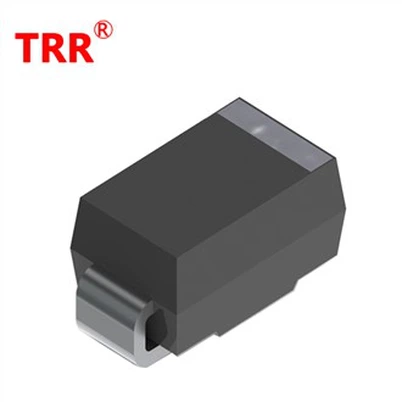
What is the difference between ordinary diodes and Schottky diodes used in photovoltaic systems?
Leave a message
一, The essential difference between physical structure and working principle
1. Ordinary diode: carrier recombination mechanism of PN junction
Ordinary diodes are based on the PN junction structure formed by P-type and N-type semiconductors, and their conduction mechanism relies on the injection and recombination of minority carriers. When forward biased, holes in the P region recombine with electrons in the N region in the depletion layer to form a current; When reverse biased, the depletion layer width increases to form a high resistance state. This structure results in the following characteristics of ordinary diodes:
High forward voltage drop: The typical value for silicon-based diodes is 0.6-0.7V, while for germanium based diodes it is about 0.2-0.3V
Long reverse recovery time: Carrier recombination takes microseconds, resulting in switch losses
Strong temperature stability: The negative temperature coefficient characteristic of PN junction makes its performance stable in the range of -40 ℃ to 150 ℃
2. Schottky diode: majority carrier transport in metal semiconductor barrier
Schottky diodes adopt a Schottky barrier structure formed by metals (such as aluminum and titanium) and semiconductors (silicon or silicon carbide), and their conduction mechanism is based on the thermionic emission effect of majority carriers (electrons). When forward biased, electrons cross the potential barrier to form a current; When reverse biased, only a few charge carriers generate microampere leakage current. This structure gives it unique advantages:
Positive pressure reduction: typical value 0.15-0.4V, silicon carbide based can be lower than 1V
Short reverse recovery time: nanosecond level response, no carrier storage effect
Small junction capacitance: excellent high-frequency characteristics, suitable for MHz level switch applications
二, Quantitative comparison of electrical performance
1. Conductivity loss and efficiency improvement
In photovoltaic inverters, the conduction loss of diodes directly affects system efficiency. Taking 20A output current as an example:
Ordinary silicon diode (VF=0.7V): Loss=20A × 0.7V=14W
Schottky diode (VF=0.3V): Loss=20A × 0.3V=6W
Efficiency has increased by 57%, and the size of the radiator can be reduced by 40%. In string inverters, the use of Schottky diodes can increase annual power generation by 2-3%.
2. Switch characteristics and high-frequency applications
In the DC-DC conversion process, the reverse recovery time of Schottky diodes (<10ns) is reduced by two orders of magnitude compared to ordinary diodes (>1 μ s). This makes it:
Implementing Zero Voltage Switching (ZVS) in Synchronous Rectification Circuit
Reduce EMI noise interference
Increase the switching frequency to MHz level and reduce the volume of magnetic components
3. Reverse leakage current and risk of thermal runaway
The reverse leakage current of Schottky diodes (10-100 μ A) is 2-3 orders of magnitude higher than that of ordinary diodes (nA level). In high temperature environments (>85 ℃), the leakage current increases exponentially, which may cause:
The temperature rise of the junction box exceeds 150 ℃, causing material aging
Bypass diode thermal runaway, burning components
Power generation efficiency decreases by 0.5-1%/℃
三, Technical adaptation for typical application scenarios
1. Bypass protection scenario
In photovoltaic modules, bypass diodes must meet the following requirements:
Quick response: When the component is obstructed, the nanosecond response of the Schottky diode can immediately divert current, preventing the formation of hot spots
Low power consumption: Taking a 300W component as an example, the conduction loss of Schottky diodes is reduced by 80% compared to ordinary diodes, and the junction box temperature drops by 50 ℃
Reliability challenge: It is necessary to pass the IEC62979 thermal escape test to ensure that the heat generated by reverse leakage current can be dissipated in a timely manner in a 90 ℃ environment
2. Inverter rectification scenario
In string inverters, Schottky diodes are used for:
Input anti backflow: prevent components from feeding power to the grid at night
Boost Circuit Continuation: Efficient Energy Conversion with MOSFET
Output rectification: replacing traditional fast recovery diodes in a transformerless topology, increasing efficiency by 1.5-2%
3. Intelligent optimizer scenario
In DC-DC optimizers, Schottky diodes work in conjunction with MOSFETs:
Low conduction voltage drop: At 30A current, a combination of 2m Ω MOSFET and Schottky diode can be used to control the junction temperature within 125 ℃
Volume optimization: Compared to multiple Schottky diodes connected in parallel, MOSFET scheme reduces PCB area by 30%
Cost balance: Although the cost of a single tube increases by 20%, the system level BOM cost decreases by 15%
四, Cost effectiveness and selection strategy
1. Initial investment comparison
Ordinary diode: unit price
0.05−
0.2, suitable for low voltage (<60V) and low current (<10A) scenarios
Schottky diode: unit price
0.2−
1.0, suitable for medium to high voltage (40-200V) and high current (>10A) scenarios
Ideal diode solution: using MOSFET+controller, unit price
1.5−
3.0, but the improvement in system efficiency can offset the cost increase
2. Full lifecycle cost
Taking a 100kW photovoltaic power station as an example:
Ordinary diode: annual power consumption
1200, maintenance cost
five hundred
Schottky diode: annual power consumption
480, maintenance cost
two hundred
5-year total cost: ordinary plan
8500vs Schottky scheme
three thousand and four hundred
3. Selection decision matrix
Parameter ordinary diode Schottky diode ideal diode scheme
Working voltage<60V 40-200V 40-1000V
Working current<10A>10A>30A
Efficiency requirement<95% 95-98%>98%
Temperature range -40 ℃ to 150 ℃ -40 ℃ to 125 ℃ -40 ℃ to 105 ℃
Cost sensitivity is high, medium, and low