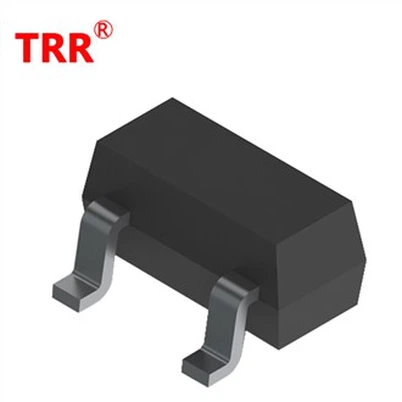
What are the applications of diodes in overvoltage protection of communication equipment?
Leave a message
1. The lightning threat and lightning protection requirements faced by communication modules
(1) Lightning threat
Lightning is a complex natural phenomenon that generates electromagnetic pulses (LEMPs) with characteristics such as high energy, wide frequency spectrum, and short rise time. When lightning strikes communication lines or nearby buildings, it can generate induced overvoltage on the communication lines, with amplitudes reaching thousands of volts or even higher, and durations ranging from a few nanoseconds to a few microseconds. In addition, lightning may also conduct to communication modules through power lines, forming power surges. If these transient overvoltages and overcurrent are not effectively suppressed, they will directly affect the sensitive electronic components inside the communication module, causing damage such as component breakdown and burnout.
(2) Lightning protection requirements
To ensure the reliable operation of communication modules in lightning environments, multi-level lightning protection measures need to be taken. Among them, using TVS diodes for local protection inside the communication module is an important means. TVS diodes can quickly conduct when transient overvoltages occur, clamp the overvoltage at a safe level, and discharge the overcurrent to ground, thereby protecting key components such as chips and circuits inside the communication module from lightning damage.
2. Working principle and key parameters of TVS diode
(1) Working principle
TVS diode is a special type of diode that, in normal operation, is in a high impedance state and has almost no impact on the normal operation of the circuit. When a transient overvoltage occurs in the circuit, the TVS diode will quickly respond, and its internal PN junction will undergo avalanche breakdown, transitioning from a high resistance state to a low resistance state, short circuiting the overvoltage to ground. After the transient overvoltage disappears, the TVS diode will automatically return to a high resistance state to continue protecting the circuit.
(2) Key parameters
Breakdown voltage (VBR): refers to the voltage value at which the TVS diode begins to conduct. When selecting, the appropriate breakdown voltage should be chosen based on the normal operating voltage of the protected circuit. Generally, the breakdown voltage should be greater than the maximum operating voltage of the protected circuit, while leaving a certain margin.
Clamp voltage (VC): When the TVS diode is turned on, the voltage at both ends is clamped at the clamp voltage value. The lower the clamping voltage, the better the protection effect on the protected circuit.
Current carrying capacity (IPP): Refers to the maximum peak pulse current that a TVS diode can withstand. The larger the current carrying capacity, the stronger the lightning energy that TVS diodes can withstand.
Response time (tR): refers to the time it takes for the TVS diode to start conducting from detecting transient overvoltage. The shorter the response time, the better the suppression effect on transient overvoltage.
3. Selection of TVS diodes in communication modules
(1) Select based on the working voltage of the communication module
The communication module has different working voltage levels, such as 3.3V, 5V, 12V, etc. When selecting TVS diodes, it should be ensured that their breakdown voltage is greater than the maximum operating voltage of the communication module, while considering factors such as voltage fluctuations and leaving a certain safety margin. For example, for a communication module with a working voltage of 3.3V, a TVS diode with a breakdown voltage of around 5V can be selected.
(2) Select the interface type based on the communication module
Communication modules typically have multiple interfaces, such as serial ports, Ethernet ports, USB interfaces, etc. Different types of interfaces have different lightning protection requirements, so it is necessary to choose appropriate TVS diodes for protection.
Serial port: Serial port signals are usually low-speed signals and require relatively low capacitance. You can choose unidirectional or bidirectional TVS diodes for protection, such as SMAJ series unidirectional TVS diodes.
Ethernet port: Ethernet port has a high transmission rate and strict requirements for signal integrity and capacitance. Low capacitance and fast response TVS diode arrays should be selected for protection, such as the SRV05-4 series TVS diode array.
USB interface: USB interfaces have different standards such as USB 2.0 and USB 3.0, which also have different requirements for lightning protection. For USB 2.0 interfaces, small package, low capacitance TVS diodes such as USBLC6-2SC6 series can be selected; For USB 3.0 interfaces, it is necessary to choose TVS diodes with higher performance to meet their high-speed transmission requirements.
(3) Select based on lightning protection level
Different application scenarios have different requirements for lightning protection levels. In areas with frequent lightning activity, it is necessary to choose TVS diodes with larger current carrying capacity and higher protection level. For example, in outdoor base stations and other scenarios, TVS diodes with a current capacity of several kilowatts, such as the 5KP series high-power TVS diodes, can be selected.
4. Application scheme of TVS diode in communication module
(1) Power line protection
The power line of the communication module is one of the main ways for lightning to invade. At the power input end, a multi-level protection scheme can be adopted. The first level can use gas discharge tubes (GDT) or varistors (MOV) for rough protection, releasing most of the lightning energy to the ground; The second level uses TVS diodes for fine protection, clamping residual transient overvoltages at a safe level. For example, a varistor can be connected in series at the power input end, followed by a TVS diode in parallel, such as the SMAJ series.
(2) Signal line protection
For the signal lines of the communication module, appropriate TVS diodes should be selected for protection based on the type and rate of the signal. Parallel TVS diodes are connected at both ends of the signal line. When a transient overvoltage occurs on the signal line, the TVS diode quickly conducts and discharges the overvoltage to ground, protecting the signal line and the back-end chip. For example, bidirectional TVS diodes such as SM8S series bidirectional TVS diodes can be used for protection on RS-485 signal lines.
(3) Grounding design
Good grounding is the key to the effective lightning protection function of TVS diodes. The grounding of communication modules should follow the principle of equipotential connection, connecting the metal casing, power ground, signal ground, etc. of the equipment together through low impedance conductors and reliably grounding them. The grounding resistance should be as small as possible, generally less than 4 Ω. At the same time, attention should be paid to avoiding the generation of grounding loops and reducing electromagnetic interference.
https://www.trrsemicon.com/diode/dip-diode/mbr10200.html