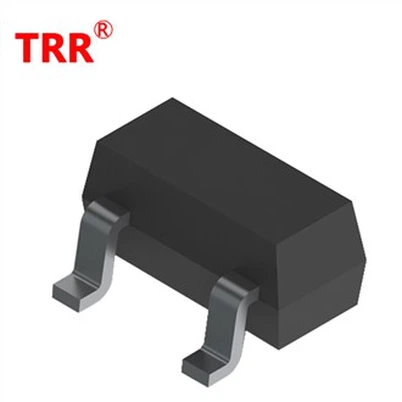
Basic knowledge of diodes in consumer electronics
Leave a message
1, The basic structure of diodes
A diode is an electronic component made of semiconductor materials such as silicon, selenium, germanium, etc. Its basic structure is a PN junction. PN junction refers to a special thin layer formed near the interface between two semiconductors in a semiconductor chip by a specific production process, where one part of the interior becomes a P-type semiconductor and the other part becomes an N-type semiconductor. PN junction has unidirectional conductivity, allowing current to flow only from the positive electrode to the negative electrode, while the opposite direction prevents current flow.
2, Types and classifications of diodes
According to the different semiconductor materials, diodes can be divided into germanium diodes (Ge tubes) and silicon diodes (Si tubes). According to their applications, there are various types of diodes, such as detector diodes, rectifier diodes, Zener diodes, switching diodes, isolation diodes, Schottky diodes, light-emitting diodes, silicon power switch diodes, rotating diodes, etc. In addition, diodes can be divided into point contact type, surface contact type, and planar type according to the different chip structures.
Rectifying diode: specifically used for power rectification, it has high forward current and reverse voltage resistance, and can convert AC power into DC power.
Zener diode: A diode made by utilizing the reverse breakdown state of a PN junction, which allows the current to vary over a large range while the voltage remains basically unchanged, and serves as a voltage regulator.
Light emitting diode: capable of converting electrical energy into light energy, commonly used in fields such as indicator lights and display lighting.
Switching diode: mainly used in rectification, detection, voltage regulation, switching, and frequency modulation circuits.
3, Working principle of diode
The working principle of diodes is based on the characteristics of PN junctions. When there is no external voltage, due to the difference in carrier concentration on both sides of the PN junction, there are diffusion currents and drift currents caused by self built electric fields, which are equal and put the diode in an electrical equilibrium state. When a forward bias voltage is applied across the PN junction, the direction of the external electric field is consistent with that of the internal electric field, which strengthens the internal electric field, widens the PN junction, hinders electron diffusion, and forms a weak reverse current. At this time, the diode is in a conducting state. When a reverse bias voltage is applied across the PN junction, the external electric field is in the opposite direction to the internal electric field, weakening the internal electric field and narrowing the PN junction, increasing the diffusion current. However, due to the effect of the internal electric field, the current is quickly limited to a very small range, and the diode is in a cut-off state.
4, Characteristics of diodes
The volt ampere characteristic of a diode refers to the relationship between the current passing through the diode and the applied voltage when a voltage is applied across the diode. If the relationship is represented by a curve, it is called a volt ampere characteristic curve.
Forward characteristic: When the forward voltage applied to the diode is very small, the forward current is very weak. Only when the forward voltage exceeds a certain value, the forward current increases significantly, and this voltage is called the conduction voltage or threshold voltage. The conduction voltage of a silicon transistor is about 0.50.6V, and the conduction voltage of a germanium transistor is about 0.10.2V. After the diode conducts, as the voltage increases, the current will rapidly increase.
Reverse characteristic: When a reverse voltage is applied across the diode, only a very small reverse current passes through. At a certain temperature, when the reverse voltage value changes, the reverse current remains basically unchanged, so it is often referred to as reverse saturation current.
Reverse breakdown characteristic: When the reverse voltage reaches a certain value, the diode enters a reverse breakdown state. At this point, as long as there is a slight change in voltage, the current value will rapidly increase. When exceeding this value, due to the effect of junction capacitance, the diode will not be able to exhibit good unidirectional conductivity.
5, The application of diodes in consumer electronics
Diodes have a wide range of applications in consumer electronics, with diverse functions as follows:
Rectification: By utilizing the unidirectional conductivity of diodes, rectification can be achieved to convert alternating current into direct current, providing stable direct current power for electronic devices.
Limiting: By utilizing the characteristic of small and basically unchanged voltage drop after diode conduction, a limiting circuit can be constructed to limit the output voltage amplitude within a certain voltage value.
Protection: In electronic circuits, diodes are often used to protect other components from damage caused by high voltage.
Signal detection: In communication systems, diodes are commonly used for tasks such as signal detection, modulation and demodulation, as well as frequency conversion, to ensure accurate transmission of information.
Logic Function: In computers and consumer electronics, diodes are used to implement various logic functions such as switching, amplification, and storage, providing support for the normal operation of devices.
Lighting: In lighting systems, especially light-emitting diodes (LEDs), they are widely used in various lighting applications due to their high efficiency, long lifespan, and environmental friendliness.
In addition, diodes play an important role in fields such as automotive electronics, industrial control systems, medical equipment, new energy, security and fire protection systems, as well as aerospace and defense.
https://www.trrsemicon.com/diode/smd-diode/1-watt-do-41-hermetically-sealed-glass-zener.html