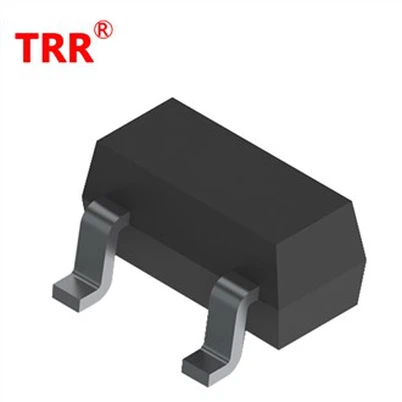
Diode Breakdown Characteristics
Leave a message
When the applied reverse voltage exceeds a certain value, the reverse current will suddenly increase, which is called electrical breakdown. The critical voltage that causes electrical breakdown is called the diode reverse breakdown voltage. The diode loses unidirectional conductivity during electrical breakdown. If the diode does not overheat due to electrical breakdown, the unidirectional conductivity will not necessarily be permanently destroyed, and its performance can be restored after removing the applied voltage, otherwise the diode will be damaged. Therefore, the reverse voltage applied by the diode should be avoided during use.
According to the mechanism, reverse breakdown can be divided into Zener breakdown and avalanche breakdown. In the case of high doping concentration, due to the small width of the barrier region and the large reverse voltage, the covalent bond structure in the barrier region is destroyed, the valence electrons are released from the covalent bond, and electron-hole pairs are generated. , resulting in a sharp increase in current, this breakdown is called Zener breakdown. If the doping concentration is low, the width of the barrier region is wide, and Zener breakdown is not easy to occur.
Another type of breakdown is avalanche breakdown. When the reverse voltage increases to a larger value, the applied electric field accelerates the electron drift speed, so that it collides with the valence electrons in the covalent bond, knocks the valence electrons out of the covalent bond, and generates new electron-hole pairs. The newly generated electron-holes are accelerated by the electric field and then knock out other valence electrons, and the carriers increase in an avalanche manner, resulting in a sharp increase in current. This breakdown is called avalanche breakdown. Regardless of the breakdown, if its current is not limited, it may cause permanent damage to the PN junction.