What parameters should be focused on when choosing solar diodes?
Leave a message
一, Electrical performance parameters: core indicators that determine system energy efficiency and safety
1. Forward voltage drop (Vf) and conduction loss
Forward voltage drop refers to the voltage drop of a diode during forward conduction, which directly affects the energy conversion efficiency of a photovoltaic system. Taking a 1000W photovoltaic array as an example, if a diode with Vf=0.5V is used, the conduction loss is 5W (accounting for 0.5% of the output power); If the ultra-low loss model with Vf=0.3V is selected, the loss can be reduced to 3W, and the annual energy savings can exceed 20 kWh (calculated based on an average daily power generation of 5 hours).
Industry Trends:
Silicon carbide (SiC) diodes, with their low Vf characteristics (0.2-0.3V), are gradually replacing traditional silicon-based diodes and are widely used in large ground power stations.
According to data from a certain photovoltaic inverter manufacturer, the use of SiC diodes increased system efficiency by 0.8% and reduced LCOE (levelized cost of electricity) by 3.2%.
2. Reverse recovery time (Trr) and high-frequency loss
In MPPT (Maximum Power Point Tracking) control of photovoltaic arrays, diodes need to frequently switch on/off states. Long reverse recovery time can lead to a significant increase in switch losses and even cause electromagnetic interference (EMI). For example, at a switching frequency of 10kHz, the diode loss of Trr=100ns is 40% higher than that of the Trr=50ns model.
Selection suggestion:
Priority should be given to fast recovery diodes (FRDs) or ultrafast recovery diodes (SRDs) with Trr ≤ 50ns, especially suitable for high-frequency applications such as string inverters.
A case study of a 50MW photovoltaic power station shows that by optimizing the diode Trr parameters, the annual power generation of the system can be increased by 1.2%, which is equivalent to reducing carbon emissions by 800 tons.
3. Reverse breakdown voltage (Vbr) and safety margin
The reverse breakdown voltage is the maximum reverse voltage that a diode can withstand, which needs to be higher than the open circuit voltage (Voc) of the photovoltaic array and leave a safety margin. For example, for an array with Voc=600V, diodes with Vbr ≥ 800V should be selected to cope with extreme operating conditions such as voltage fluctuations and lightning strikes.
Industry standards:
The IEC 62109 standard requires that the diode Vbr must be ≥ 1.25 times the array Voc and must pass a temperature cycling test from -40 ℃ to+85 ℃.
Due to the use of diodes with insufficient Vbr in a distributed photovoltaic project, 30% of the components were damaged after lightning strikes, resulting in direct economic losses exceeding 500000 yuan.
4. Rated current (If) and thermal design
The rated current should cover the maximum output current of the photovoltaic array and take into account the temperature reduction factor. For example, in an environment of 50 ℃, the rated current of a diode needs to be reduced by 20% -30% compared to 25 ℃. In addition, the heat dissipation performance needs to be evaluated through the thermal resistance (R θ JA) parameter to avoid performance degradation caused by overheating.
Thermal management plan:
By using copper substrates or heat sinks to reduce thermal resistance, a household photovoltaic system optimized its heat dissipation design, reducing the diode junction temperature by 15 ℃ and extending its lifespan by three times.
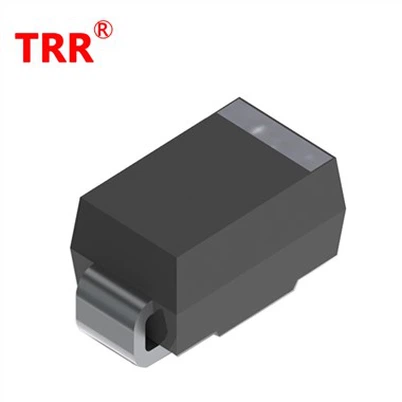
It is recommended to choose surface mount diodes with R θ JA ≤ 10 ℃/W, which are suitable for space limited micro inverter scenarios.
二, Environmental adaptability parameters: a "protective shield" to cope with extreme working conditions
1. Working temperature range (Tj)
Photovoltaic systems often face an extreme temperature range of -40 ℃ to+85 ℃, and diodes need to maintain stable performance within this range. For example, measured data from a desert photovoltaic power station shows that traditional diodes increase Vf by 15% at high temperatures, resulting in an annual loss of 2.1% in power generation; The loss of wide temperature range models (-55 ℃ to+175 ℃) is only 0.3%.
Material Innovation:
Gallium nitride (GaN) diodes are an ideal choice for high-temperature applications due to their high bandgap characteristics. After adopting GaN diodes in a certain car mounted photovoltaic system, the efficiency increased by 5% at 60 ℃.
2. Radiation resistance (TID)
For space photovoltaics or high-altitude applications, diodes need to have the ability to resist Total Ionizing Dose (TID) radiation. For example, aerospace grade diodes need to pass a 100krad (Si) radiation test to ensure that their performance does not degrade within 10 years in the space environment.
Ground application extension:
The Qinghai Tibet Plateau photovoltaic power station has reduced the module attenuation rate from 0.8%/year to 0.3%/year by selecting radiation resistant models, generating an additional 12% of electricity during its 25 year lifecycle.
3. Protection level (IP)
Diodes installed outdoors shall be dust-proof and waterproof, and IP65 and above can withstand rainstorm, sand and dust and other harsh environments. A case study of a coastal photovoltaic power station shows that IP67 diodes have a 100% pass rate in salt spray testing, while IP65 diodes have a failure rate of 15%.
三, Reliability index: the key factor determining the lifecycle cost of a system
1. Failure rate (FIT) and MTBF
Failure In Time (FIT) refers to the number of failures that occur every 1 billion hours, and MTBF (Mean Time Between Failures) is its reciprocal. For example, a diode with FIT=100 has an MTBF of 100000 hours (approximately 11.4 years), which is much higher than the 25 year design life requirement for photovoltaic systems.
Industry data:
According to statistics from a certain manufacturer, photovoltaic systems using automotive grade diodes have a failure rate of only 0.2% within 5 years, while ordinary industrial grade models have a failure rate of 3.5%.
2. ESD protection level
Human body electrostatic discharge (ESD) may damage diodes, so it is necessary to choose a model that meets HBM (human body model) ≥ 8kV and CDM (device charging model) ≥ 2kV requirements. According to actual testing on a photovoltaic module production line, the defect rate of diodes without ESD protection reached 5%, while the protection model was only 0.1%.
3. Certification and compliance with standards
Priority should be given to products that have passed international certifications such as UL, T Ü V, CE, etc., to ensure compliance with safety regulations such as IEC 62109 and IEC 61730. A photovoltaic project exported to Europe was detained by customs due to diodes not passing CE certification, resulting in delivery delays and direct losses exceeding 2 million yuan.
四, Cost benefit analysis: the 'golden rule' for balancing performance and investment
1. Initial procurement cost vs. full lifecycle cost
Although the unit price of SiC diodes is 3-5 times that of silicon-based models, their energy efficiency improvement can offset the additional costs. For example, after adopting SiC diodes in a 100MW power station, the initial investment increased by 8 million yuan, but the electricity cost was saved by 120 million yuan within a 25 year lifecycle, and the IRR (internal rate of return) increased by 2.3 percentage points.
2. Balance between standardization and customization
Standardized products can reduce procurement and inventory costs, but customized models can better match specific scenario requirements. For example, a certain micro inverter manufacturer successfully entered the limited space Japanese market by customizing low profile diodes and compressing the product thickness from 8mm to 3mm.
3. Supply chain stability
Choose suppliers with sufficient production capacity and short delivery cycles to avoid project delays caused by stock shortages. A global TOP5 photovoltaic company has shortened the delivery cycle from 12 weeks to 4 weeks and increased annual capacity utilization by 15% by establishing a strategic inventory agreement with diode manufacturers.
五, Industry case: Practical wisdom in parameter selection
Case 1: "High temperature Campaign" for Desert Photovoltaic Power Stations
A 500MW desert power station in the Middle East is facing the challenge of a high temperature of 60 ℃. Traditional silicon-based diodes experience an increase in Vf and an extension of Trr at high temperatures, resulting in a 1.8% decrease in system efficiency. By switching to GaN diodes (Vf=0.25V, Trr=30ns), the efficiency improved to 98.5% and the annual power generation increased by 28 million kWh.
Case 2: The "anti-corrosion revolution" of offshore photovoltaics
The Jiangsu Rudong offshore photovoltaic project uses IP68 protection level diodes, combined with nano coating technology, to achieve zero failure rate within 5 years in an environment with salt spray concentration exceeding 5 times the conventional level, while the traditional model has an annual failure rate of 8%.
Case 3: Cost optimization of household photovoltaics
A certain household's photovoltaic system uses surface mounted diodes with Vf=0.3V and R θ JA=8 ℃/W to reduce heat dissipation costs by 30% while maintaining efficiency, shortening the system's investment payback period to 6 years.