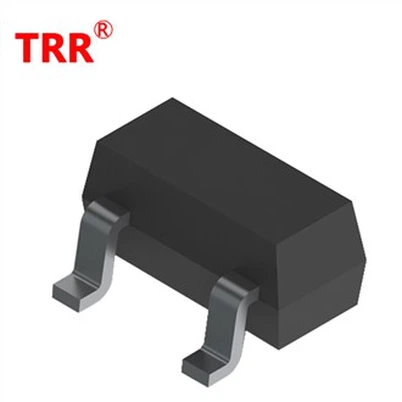
What is the voltage drop of a Zener diode?
Leave a message
1, Positive conduction voltage drop
When a Zener diode is forward biased, its working principle is similar to that of a regular silicon diode. When the forward voltage gradually increases to a certain threshold, the Zener diode begins to conduct, allowing current to pass through. At this point, the voltage drop across the diode is the forward conduction voltage drop. Based on extensive experimental data and fundamental principles of semiconductor physics, the forward conduction voltage drop of a typical Zener diode made of silicon material is typically between 0.6 and 0.7 volts. This numerical range is based on Zener diodes made of standard silicon materials, but it should be noted that the forward conduction voltage drop of Zener diodes made of different materials or special processes may vary.
The specific value of forward conduction voltage drop is influenced by various factors, including the manufacturing material, process, temperature, and current magnitude of the diode. For example, diodes made of silicon and germanium materials have differences in forward conduction voltage drop. In addition, as the temperature increases, the forward conduction pressure drop may slightly decrease. Therefore, in practical applications, it is necessary to comprehensively consider these factors to select the appropriate Zener diode.
2, Reverse breakdown voltage drop
One of the more important characteristics of a Zener diode is its reverse breakdown voltage drop. In the reverse bias state, as the voltage gradually increases to the breakdown voltage of the Zener diode, the diode begins to conduct in reverse, and the voltage drop across the diode is almost equal to its breakdown voltage. The breakdown voltage of a Zener diode is a relatively stable value, although it slightly increases with the increase of Zener current, in practical applications, it can be considered that its breakdown voltage is constant.
The reverse breakdown voltage drop characteristic of Zener diodes makes them important for voltage regulation and voltage limiting applications. By designing the circuit reasonably, the Zener diode can maintain relative stability of the output voltage when the power supply voltage fluctuates, providing protection for other components in the circuit.
3, Factors affecting pressure drop
The voltage drop characteristics of Zener diodes are influenced by various factors, mainly including the following aspects:
Manufacturing materials and processes: Zener diodes manufactured with different materials and processes may have different voltage drop characteristics. For example, diodes made of silicon and germanium materials have differences in forward conduction voltage drop and reverse breakdown voltage drop.
Temperature: As the temperature increases, the forward conduction voltage drop of the Zener diode may slightly decrease, and the reverse breakdown voltage drop may also be affected. Therefore, when using Zener diodes in high-temperature environments, the influence of temperature on voltage drop characteristics needs to be considered.
Current magnitude: The current magnitude also affects the voltage drop characteristics of the Zener diode. In the forward conducting state, as the current increases, the voltage drop across the diode may slightly increase. In the reverse breakdown state, although the breakdown voltage is relatively stable, it may slightly increase with the increase of the Zener current.
Packaging form: The packaging form of a Zener diode can also affect its voltage drop characteristics. Zener diodes with different packaging forms have differences in heat dissipation performance, mechanical strength, and other aspects, which affect their voltage drop characteristics.
4, Application examples
Zener diodes have a wide range of applications in electronic circuits. For example, in a regulated power supply circuit, a Zener diode can be used as a regulator element in series with a current limiting resistor to maintain the stability of the output voltage. In an overvoltage protection circuit, a Zener diode can be connected in parallel at both ends of the circuit to be protected. When an overvoltage occurs in the circuit, the Zener diode quickly conducts, releasing excess voltage to ground and protecting other components in the circuit from damage.
In addition, Zener diodes can also be used in reference voltage sources, limiters, and other circuits to provide stable voltage reference and signal limiting functions for the circuit.
https://www.trrsemicon.com/diode/surfact-mount-switching-diodes-bav16ws.html