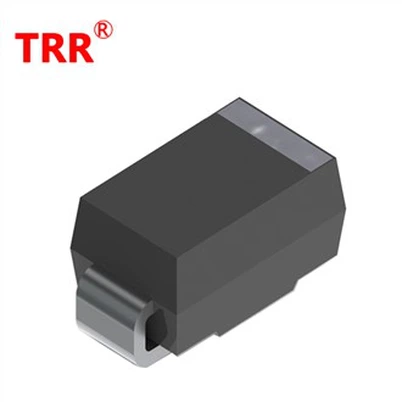
What is the voltage drop of a surface mount diode?
Leave a message
1, Definition and measurement of voltage drop in surface mount diodes
The voltage drop of a surface mount diode, in short, refers to the voltage difference between its two ends when the diode is conducting in the forward direction. This parameter is directly related to the conductivity characteristics of the PN junction inside the diode, as well as the magnitude of the current passing through the diode. In an ideal situation, when a diode is fully conductive, its voltage drop should be as small as possible to reduce energy loss in the circuit. However, in practical applications, the voltage drop may vary due to differences in diode materials, processes, and working conditions.
Measuring the voltage drop of surface mount diodes usually requires the use of electronic measuring instruments such as multimeters or oscilloscopes. During the measurement process, it is necessary to ensure that the diode is in a forward conducting state, with its positive pole connected to the positive pole of the power supply and its negative pole connected to the negative pole of the power supply. By measuring the voltage across the diode, the voltage drop value can be obtained. It is worth noting that due to the nonlinear voltage current relationship of diodes, the voltage drop value will vary with the current passing through the diode.
2, Voltage drop differences of different types of surface mount diodes
Surface mount diodes can be classified into various types based on their materials, structures, and applications, such as silicon diodes, germanium diodes, light-emitting diodes (LEDs), and voltage regulators. There are significant differences in voltage drop characteristics among these different types of surface mount diodes.
Silicon diode: Silicon diode is one of the most common types of diodes in electronics. When conducting in the forward direction, the voltage drop of a silicon diode is usually between 0.6V and 0.7V. This voltage drop value is relatively stable and less affected by temperature, so silicon diodes are widely used in circuit design.
Germanium diode: Compared with silicon diode, germanium diode has a lower voltage drop, usually between 0.2V and 0.3V. However, due to the poor thermal stability of germanium materials, the performance of germanium diodes will decrease in high-temperature environments, so their application range is relatively limited.
Light Emitting Diode (LED): As a special type of diode, LED's main function is to convert electrical energy into light energy. The voltage drop of LED varies depending on the color of its light emission. For example, the voltage drop of red LED is usually between 1.8V and 2.2V, the voltage drop of yellow LED is about 1.8V to 2.0V, and the voltage drop of green LED may be as high as 3.0V to 3.2V. In addition, the voltage drop of LED is also affected by its rated current, and the rated current of LED during normal light emission is usually about 20mA.
Zener diode: Zener diode is a diode used to stabilize the voltage in a circuit. Its voltage drop characteristics are quite unique, that is, the voltage drop value of the voltage regulator diode remains relatively stable in different current ranges. This characteristic makes the voltage regulator diode widely applicable in power supply circuits, voltage regulator circuits, and other situations.
3, Considerations for voltage drop of surface mount diodes in practical applications
In electronic circuit design, the voltage drop of surface mount diodes is an important parameter that cannot be ignored. The following are several key factors that need to be considered in practical applications:
Circuit efficiency: Voltage drop directly affects energy loss in the circuit. Therefore, in circuits that pursue high efficiency, diodes with lower voltage drop should be selected.
Stability: In some applications, such as voltage stabilization circuits, it is required that the voltage drop of the diode remains relatively stable within a certain range. At this point, a diode type with good stability should be selected.
Temperature characteristics: Due to the influence of temperature on the voltage drop of diodes, the temperature characteristics of diodes need to be considered in circuits operating in high or low temperature environments. For example, the voltage drop of silicon diodes is less affected by temperature, so they have good stability in high temperature environments.
Cost: Different types of surface mount diodes have price differences. When selecting diodes, it is necessary to consider cost factors while meeting performance requirements.
https://www.trrsemicon.com/diode/smd-diode/silicon-rectifiers-sm4007-ll4007.html