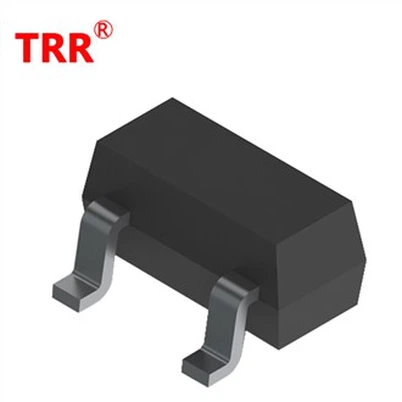
What is the purpose of a Zener diode?
Leave a message
The basic principle of Zener diode
Before understanding the purpose of a Zener diode, it is necessary to have a basic understanding of its working principle. Zener diodes are structurally similar to ordinary diodes, but they undergo special processing during the manufacturing process to enter the breakdown region and maintain stable current flow when the reverse voltage reaches a certain value, without being damaged by excessive reverse voltage like ordinary diodes. This characteristic enables the Zener diode to provide a stable output voltage within a specific voltage range, thereby playing a stabilizing role.
One of the main uses: voltage stability
One of the most widely used applications of Zener diodes is as voltage stabilizers. In many electronic devices, a stable power supply voltage is a key factor in ensuring normal operation and extending the service life of the equipment. Zener diodes can absorb excess voltage fluctuations in the circuit, limiting the output voltage to a preset, very small range, which is crucial for protecting subsequent circuits from the impact of voltage transients. For example, in computer power supply units, Zener diodes are used to stabilize key voltage rails such as 5V and 12V, ensuring the stable operation of components such as CPU, memory, and hard disk.
Purpose 2: Protect the circuit
In addition to its voltage stabilizing function, Zener diodes are also commonly used for circuit protection. In transient voltage suppression (TVS) circuits, Zener diodes can quickly respond to sudden overvoltage events in the circuit, such as lightning strikes or power surges, by absorbing these high-energy pulses to protect other sensitive components from damage. In addition, in automotive electronic systems, Zener diodes are used to prevent damage to electronic control units (ECUs) and other electronic components caused by transient high voltage generated by the ignition system.
Usage Three: Reference Voltage Source
Zener diodes are often used as reference voltage sources in precision circuits due to their stable voltage characteristics. In both analog and digital circuits, a stable reference voltage is the foundation for achieving precise measurement and control. By connecting Zener diodes in series or parallel, a voltage reference with extremely low temperature coefficient and high stability can be constructed, which is crucial for the performance of precision electronic components such as analog-to-digital converters (ADCs), digital to analog converters (DACs), and operational amplifiers.
Usage 4: Temperature compensation
The breakdown voltage of a Zener diode follows a certain pattern with temperature, which makes it an effective temperature compensation component in certain applications. For example, in the thermistor temperature measurement circuit, through clever design, the negative temperature coefficient characteristic of the Zener diode can be utilized to compensate for the positive temperature coefficient of the thermistor, thereby improving the accuracy of temperature measurement.
Usage 5: Special functional circuits
With the development of technology, Zener diodes are also used in some special functional circuits, such as limiting circuits, threshold circuits, overvoltage protection circuits, etc. In communication systems, Zener diodes can be used to limit the maximum amplitude of signals and prevent signal distortion; In audio amplification circuits, it can serve as a limiter to prevent damage to the speaker due to excessive power input.
https://www.trrsemicon.com/diode/smd-diode/surface-mount-schottky-barrier-rectifier-ss36.html