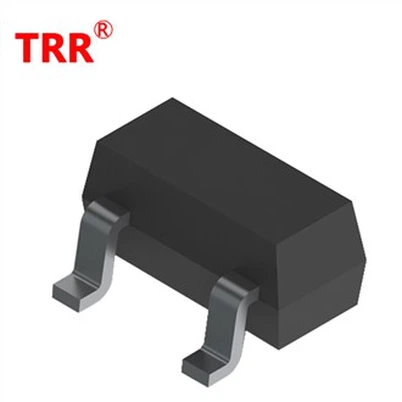
What does a diode look like?
Leave a message
1, The appearance of a diode
A diode, as the name suggests, is an electronic device composed of two electrodes (anode and cathode) and a semiconductor material between them. In appearance, diodes are usually presented as a compact cylindrical or rectangular package, and their size varies depending on the application field and power requirements. Common forms of diode packaging include glass packaging, plastic packaging, and metal packaging.
Glass encapsulated diodes are commonly used in special applications such as high voltage and high frequency. They appear as transparent glass tubes, and the PN junction made of semiconductor material and the metal wires connecting the electrodes can be clearly seen inside. This packaging form not only has good insulation performance, but also effectively prevents external pollution from affecting the internal structure of the diode.
Plastic encapsulated diodes are more common and widely used in various electronic devices. They usually appear as black or blue plastic shells with information such as model and polarity markings printed on the surface. This packaging form not only has low cost, but also has good moisture and dust resistance, which can effectively extend the service life of diodes.
Metal encapsulated diodes are commonly used in high-power, high current applications such as rectifiers, power amplifiers, etc. Its appearance presents a sturdy metal shell, filled with heat dissipation materials to ensure the stability and reliability of the diode under high-power operation.
2, Internal structure of diode
The internal structure of a diode is mainly composed of PN junctions made of semiconductor materials (such as silicon or germanium) and metal wires connecting the electrodes. The PN junction is the core part of a diode, which is formed by doping certain regions of a semiconductor material into P-type (high hole concentration) and N-type (high electron concentration), and forming a narrow transition region (i.e. depletion layer) between the two.
When the diode is forward biased (i.e. the anode is connected to a positive power supply and the cathode is connected to a negative power supply), the depletion layer becomes thinner, allowing current to pass through. At this point, the diode is in a conducting state with low resistance, allowing current to flow smoothly. When the diode is reverse biased (i.e. the anode is connected to a negative power supply and the cathode is connected to a positive power supply), the depletion layer thickens, preventing current from passing through. At this point, the diode is in an off state, with extremely high resistance and almost no conductivity.
3, Functional characteristics of diodes
The functional characteristics of diodes are mainly reflected in their unidirectional conductivity. This characteristic makes diodes play an important role in circuits such as rectification, voltage regulation, amplification, and switching.
In a rectifier circuit, diodes convert alternating current into direct current. By controlling the conduction and cutoff states of diodes, the negative and positive half cycles of AC power can be cut off and retained respectively, thereby achieving the conversion of AC power to DC power.
In a voltage regulator circuit, a diode stabilizes the output voltage by adjusting its operating point. When the input voltage changes, the diode will automatically adjust its conductivity to maintain the stability of the output voltage. This voltage stabilizing characteristic is of great significance for protecting other components in the circuit and improving the stability of the circuit.
In amplification circuits, diodes can amplify weak input signals into stronger output signals. By adjusting the bias voltage of the diode and the magnitude of the input signal, the amplitude and phase of the output signal can be controlled, thereby achieving signal amplification and processing.
In a switching circuit, diodes act as switching elements and achieve the switching function of the circuit by controlling their conduction and cutoff states. This switching characteristic has enabled diodes to be widely used in fields such as digital circuits and logic circuits.
https://www.trrsemicon.com/diode/dip-diode/diode-sr5200-factory.html