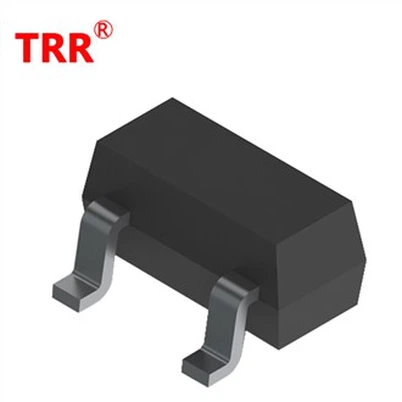
The role of diodes in battery management systems
Leave a message
1, Overview of Battery Management System
The Battery Management System (BMS) is the "brain" of the battery system, responsible for monitoring key parameters such as voltage, current, and temperature of the battery pack, and controlling the charging and discharging, balancing, thermal management, and fault warning of the battery based on these parameters. The goal of BMS is to ensure that the battery pack operates under safe, efficient, and long-lasting conditions, while improving the reliability and stability of the entire battery system.
2, Basic principles and characteristics of diodes
A diode is an electronic component with unidirectional conductivity, composed of a PN structure formed by a P-type semiconductor and an N-type semiconductor. When a voltage higher than the negative electrode (cathode) is applied to the positive electrode (anode) of a diode, the diode conducts and current can flow from the positive electrode to the negative electrode; When the positive voltage of the diode is lower than the negative voltage, the diode cuts off and the current hardly flows. This unidirectional conductivity enables diodes to perform various functions in circuits, such as rectification, voltage regulation, and switching.
3, Application of diodes in battery management systems
In battery management systems, the application of diodes is mainly reflected in the following aspects:
Prevent overcharging and overdischarging of batteries
One of the most important roles of diodes in battery management systems is to prevent overcharging and overdischarging of batteries. During the charging process, when the battery voltage reaches the preset upper limit, the BMS will control the diode in the charging circuit to cut off the charging current and prevent overcharging of the battery. Similarly, during the discharge process, when the battery voltage drops to the preset lower limit, the BMS will control the diode in the discharge circuit to cut off the discharge current and prevent the battery from overdischarging. This protective effect can significantly extend the service life of the battery and prevent damage due to overcharging or overdischarging.
Realize battery balancing
In battery packs, due to differences in manufacturing processes, usage conditions, and other factors, the voltage and capacity of each individual cell may vary. This difference can lead to uneven charging and discharging of the battery pack, affecting its overall performance and lifespan. To address this issue, BMS typically employs battery balancing technology. Diodes play a crucial role in battery balancing circuits. By controlling the conduction and cutoff of diodes, energy from higher voltage individual cells can be transferred to lower voltage individual cells, achieving balance in the battery pack. This balancing effect can significantly improve the overall performance and lifespan of the battery pack.
Provide reverse voltage protection
In battery management systems, diodes can also provide reverse voltage protection. When the battery pack is connected to an external circuit, if there is an abnormal situation in the external circuit, such as reverse connection or short circuit, it may cause the battery pack to be impacted by reverse voltage. This reverse voltage may cause serious damage to the battery pack. To solve this problem, BMS can connect a diode in parallel at the input end of the battery pack. When a reverse voltage appears in the external circuit, the diode will reverse breakdown and conduct, releasing the reverse voltage to the ground to protect the battery pack from damage.
As a switching element
In battery management systems, diodes can also serve as switching elements to control the on/off of circuits. For example, during the charging process, BMS can control the on/off of the charging circuit by controlling the conduction and cutoff of the diode; During the discharge process, BMS can control the on/off of the discharge circuit by controlling the conduction and cutoff of the diode. This switch function not only improves the flexibility and controllability of the battery management system, but also prevents problems such as circuit short circuits or damage caused by misoperation or abnormal situations.
4, Diode selection and optimization design
In battery management systems, the selection and optimization design of diodes are crucial for improving system performance and stability. On the one hand, it is necessary to select diodes with appropriate breakdown voltage, reverse leakage current, and forward conduction voltage drop characteristics to ensure their normal operation in battery management systems. On the other hand, it is also necessary to optimize the design of diodes, such as adopting low-power, high reliability packaging forms, improving the heat dissipation performance of diodes, etc., in order to further improve the efficiency and safety of battery management systems.
5, The development trend of diodes in battery management systems
With the rapid development of emerging markets such as electric vehicles, energy storage systems, and smart grids, the demand for battery management systems will continue to rise. In this context, the application of diodes in battery management systems will also show a more diversified and intelligent trend. On the one hand, with the continuous advancement of battery technology and the expansion of battery pack size, the performance requirements for diodes are also increasing. This requires diodes to have higher breakdown voltage, lower reverse leakage current, and faster response speed. On the other hand, with the rapid development of technologies such as the Internet of Things and big data, battery management systems will be increasingly applied to smart devices and systems. This requires diodes to maintain high performance while also possessing characteristics such as low power consumption, high reliability, and ease of integration.
https://www.trrsemicon.com/diode/smd-diode/sod-123-switching-diode-1n4148w.html