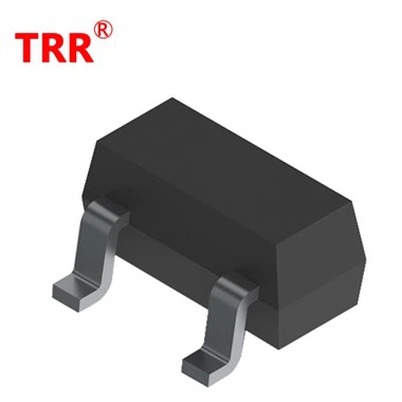
The advantages of triode transistors in amplification circuits
Leave a message
Basic working principle
Transistors, also known as transistors, are mainly divided into two types: NPN and PNP. They consist of three regions: emitter (E), base (B), and collector (C). By applying different voltages between these three regions, the transistor can achieve functions such as signal amplification, switching, and oscillation.
Basic structure
NPN type: composed of two N-type semiconductors and one P-type semiconductor, with current flowing from the emitter to the collector.
PNP type: composed of two P-type semiconductors and one N-type semiconductor, with current flowing from the collector to the emitter.
working condition
Amplification state: The base emitter junction is forward biased, and the collector base junction is reverse biased. At this time, the transistor operates in the amplification region.
Saturation state: Both the base emitter junction and the collector base junction are forward biased, and the transistor is fully conductive.
Cut off state: Both the base emitter junction and the collector base junction are reverse biased, and the transistor is completely cut off.
Main advantages in amplifying circuits
Transistors have multiple significant advantages in amplification circuits, which have led to their widespread application in various electronic devices.
High gain
The current gain (β value) of a transistor is usually high, which can achieve significant signal amplification. The typical beta values of NPN and PNP transistors are between 100 and 300, which means that small changes in input current can produce significant current amplification at the output.
High input impedance and low output impedance
High input impedance reduces its impact on the load of the front-end circuit, while low output impedance is beneficial for driving the back-end circuit. This characteristic makes the transistor very suitable for signal amplification and matching circuits.
Good linearity
When working in the amplification area, the output characteristic curve of the transistor is close to linear, which helps to maintain the original waveform of the signal and reduce distortion. This is particularly important for signal processing in high fidelity audio amplifiers and precision measuring instruments.
Wide frequency response
It has a wide frequency response range and can amplify various signals from DC to high frequency. Modern high-frequency transistors can even operate in the GHz frequency band, making them widely used in wireless communication and RF circuits.
Good stability
Stable working characteristics and good adaptability to temperature and voltage changes. By designing appropriate bias circuits, the stability and reliability of transistor amplification circuits can be further improved.
Application examples of amplifying circuits
There are various forms of transistor amplification circuits in practical applications, and the following are some common application examples:
Common emitter amplifier circuit
The common emitter amplifier circuit is one of the most common transistor amplifier circuits. The input signal is introduced from the base, the output signal is taken out from the collector, and the emitter is grounded. This circuit has high voltage gain and large input impedance, making it suitable for general signal amplification.
Common base amplifier circuit
In a common base amplifier circuit, the input signal is introduced from the emitter, the output signal is taken out from the collector, and the base is grounded. This circuit has low input impedance and high output impedance, a wide frequency response range, and is suitable for high-frequency signal amplification.
Collective amplification circuit
The lumped amplifier circuit is also known as the emitter follower. The input signal is introduced from the base, the output signal is taken out from the emitter, and the collector is connected to the power supply. This circuit has the characteristics of a voltage gain of 1, high input impedance, and low output impedance, and is commonly used for signal buffering and impedance matching.
Differential amplification circuit
The differential amplification circuit consists of two identical transistors, which can amplify the difference between two input signals while suppressing common noise. This circuit has good common mode rejection ratio and high input impedance, and is widely used in operational amplifiers and high-precision measurement circuits.
Future development direction
With the continuous advancement of electronic technology, transistor amplification circuits are also constantly innovating and developing. The future research and application directions mainly include the following aspects:
New materials and new processes
With the development of semiconductor materials science, the application of new materials such as carbon nanotubes and graphene will further enhance the performance of transistors. The new manufacturing process will make the size of the transistor smaller, faster, and lower in power consumption.
Integration and miniaturization
Modern electronic devices have increasingly high requirements for size and power consumption. Integrated and miniaturized transistor amplification circuits will be widely used in embedded systems, wearable devices, and mobile terminals.
High frequency and ultra-high frequency applications
With the development of 5G and millimeter wave technology, the demand for high-frequency and ultra-high frequency transistors will continue to grow. High frequency transistor amplification circuits will be applied in fields such as wireless communication, radar, and satellite communication.
Low power consumption and high efficiency
In the context of increasing energy scarcity, low-power and high-efficiency transistor amplification circuits will become a research focus. By optimizing circuit design and material selection, power consumption can be further reduced, efficiency can be improved, and green electronic technology can be achieved.
https://www.trrsemicon.com/transistor/small-signal-transistor/bav99-sot-23.html