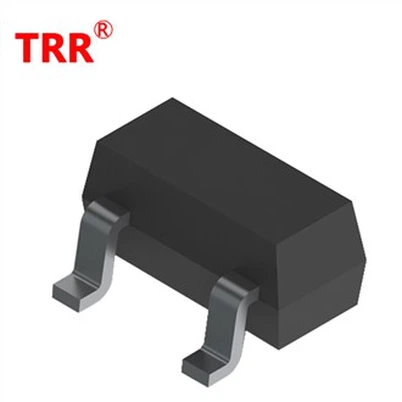
Operating principle of TVS diodes
Leave a message
Operating principle of TVS device
Transient (transient) voltage suppression diodes, referred to as TVS devices, under specified reverse application conditions, when subjected to a high energy transient overvoltage pulse, their operating impedance can immediately drop to a very low conduction value, allowing large currents to pass through, and clamping the voltage to a predetermined level, effectively protecting precision components in electronic circuits from damage.
TVS can withstand instantaneous pulse power of up to kilowatts, and its clamping response time is only 1 ps (10 ^ - 12S).
The allowable forward surge current of TVS can reach 50-200A at T=25 ℃ and T=10ms.
Bidirectional TVS can absorb instantaneous large pulse power in both positive and negative directions, and clamp the voltage to a predetermined level. Bidirectional TVS is suitable for AC circuits, while unidirectional TVS is generally used for DC