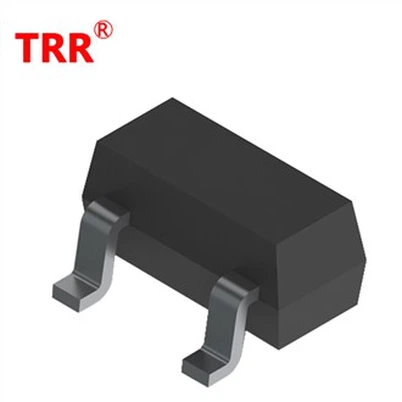
How to use diodes to improve the signal quality of wireless communication?
Leave a message
1. The basic working principle of diodes
A diode is a semiconductor device with two electrodes that has unidirectional conductivity, allowing current to flow only from the positive electrode (anode) to the negative electrode (cathode), while in the reverse direction it exhibits a high resistance state and is almost non-conductive. The core part is the PN junction formed by P-type semiconductor and N-type semiconductor. At the interface of PN junction, due to the difference in carrier concentration, a space charge layer and self built electric field will be formed. When there is no external voltage, the PN junction is in electrical equilibrium, and the diffusion current and drift current are equal. When a forward voltage is applied, the external electric field and the self built electric field cancel each other out, reducing the potential barrier of the PN junction, allowing carriers (electrons and holes) to cross the PN junction and form a current. When a reverse voltage is applied, the combined effect of the external electric field and the self built electric field enhances the potential barrier of the PN junction, preventing the movement of charge carriers. The current is very small, and the diode is in a cut-off state. When the reverse voltage increases to a certain extent, an electric field strength will be generated in the PN junction, which may cause two phenomena: Zener breakdown and avalanche breakdown.
Diodes have various characteristics and can be applied in different electronic circuits. For example, its rectification characteristics can convert AC signals into DC signals, which is the most basic application of diodes; In digital circuits, diodes can be used as switches to control the on/off of current; It can also limit the voltage amplitude and protect the circuit from damage caused by excessive voltage; Extracting information from modulated radio signals; Under reverse breakdown voltage, diodes can stabilize voltage and serve as voltage regulators; Variable capacitance diodes can be used as adjustable capacitors to regulate the frequency response of circuits.
2. The role of diodes in wireless communication
In wireless communication systems, diodes can play multiple roles. Firstly, it can enhance the transmission distance and quality of signals. Through rectification and modulation functions, diodes can process signals, making them more stable during transmission, reducing signal attenuation and distortion, thereby improving the performance and reliability of communication systems. Secondly, diodes can be used to control the power of microwave signals. By adjusting the bias voltage of the diode or the amplitude of the input signal, the output power of the microwave signal can be controlled to achieve power regulation and control, meeting the needs of different communication scenarios.
3. Specific methods for improving wireless communication signal quality using diodes
(1) Application of PIN diode
The full name of PIN diode is "Positive Intrinsic Negative Diode", which has a special structure consisting of an intrinsic semiconductor layer (I layer) sandwiched between two highly doped semiconductors (P layer and N layer). This unique design enables PIN diodes to have extraordinary switching speed and low loss characteristics, enabling rapid response in high-speed circuits and precise control of signals.
In the field of wireless communication, PIN diodes can be used for antenna tuning systems. It can quickly adjust the matching status of the antenna, ensuring that the signal can maintain the best transmission effect in different environments. This not only improves the reliability of wireless communication, but also significantly expands the communication coverage range. For example, in 5G and even future 6G communication technologies, there is an increasing demand for signal transmission speed, stability, and efficiency. PIN diodes, with their fast response capability and low loss characteristics, have demonstrated their potential in high-speed switch circuits and become key components for achieving precise control of high-frequency signals.
In addition, PIN diodes have shown great potential in fields such as radar systems, satellite communication, and the Internet of Things. In radar systems, the high sensitivity and fast response capability of PIN diodes enable the radar to detect and track targets more accurately, improving the performance and reliability of the radar system. In satellite communication, PIN diodes can ensure stable signal transmission in complex space environments, providing strong support for the smooth progress of satellite communication. In the field of the Internet of Things, the low-power characteristics of PIN diodes enable IoT devices to operate for longer periods of time, reducing energy consumption and operating costs.
(2) The application of varactor diodes
Variable capacitance diodes, also known as reactive diodes, are widely used in the field of wireless communication due to their unique adjustable capacitance characteristics. By adjusting its capacitance value, precise frequency signals can be generated for frequency control in communication systems. In automatic frequency control and tuning circuits, varactor diodes play an important role. For example, in the tuning circuit of a television receiver, a varactor diode can achieve automatic channel selection and tuning.
Varactor diodes can be used in electronic tuning systems to tune circuits by changing their capacitance to adapt to different frequency bands or requirements. In microwave circuits, varactor diodes can be used to adjust the waveform and phase of signals, achieving shaping and filtering of microwave signals. In high-frequency power conversion circuits, varactor diodes can be used to regulate high-frequency currents, achieve power conversion and control. By adjusting the capacitance value of the varactor diode, precise frequency signals can be generated for frequency control in communication systems. In oscillating circuits, varactor diodes are used as variable capacitors to stabilize the oscillation frequency and improve the performance of the oscillator. By utilizing the adjustable capacitance characteristics of varactor diodes, tunable filters can be designed. This type of filter can adjust the filtering frequency as needed and is widely used in fields such as wireless communication and radar systems. In addition, varactor diodes are also used for phase adjustment of antenna arrays in phased array radar, as well as integration with other components to form highly integrated functional modules, in order to improve the overall performance and reliability of the system.
4. Strategies for improving wireless communication signal quality using diodes
(1) Reasonable selection and configuration of diodes
Select the appropriate diode type and parameters based on the specific requirements of the wireless communication system. For example, in scenarios that require fast switching and low loss, PIN diodes are preferred; In circuits that require frequency control and tuning, choose varactor diodes. At the same time, the bias voltage of the diode and the amplitude of the input signal should be reasonably configured to achieve the best signal processing effect.
(2) Optimize circuit design
Optimize the design of wireless communication circuits based on the characteristics of diodes. For example, when designing an antenna tuning system, fully utilizing the fast response and low loss characteristics of PIN diodes to design efficient antenna tuning circuits; When designing frequency control circuits, the capacitance adjustable characteristics of varactor diodes are utilized to achieve precise frequency control.
(3) Combining other technological means
Combining diodes with other technological means, such as antenna technology, modulation and demodulation technology, further improves the quality of wireless communication signals. For example, by optimizing antenna design to enhance signal transmission and reception capabilities; Adopting advanced modulation and demodulation techniques to improve signal transmission efficiency and anti-interference ability.
https://www.trrsemicon.com/diode/smd-diode/switching-diode-ll4148.html