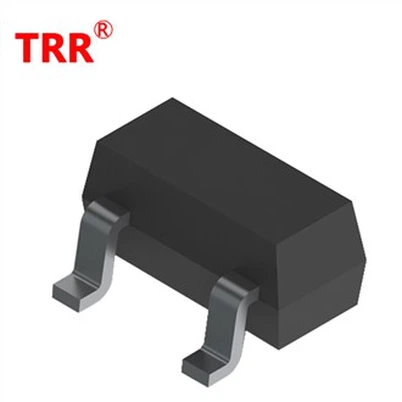
How to test NPN transistors with a multimeter?
Leave a message
1, Preparation before testing
Choose a suitable multimeter: Ensure that the multimeter has the function of testing diodes, resistors, and voltages, as these functions are all used when testing NPN transistors.
Understand the basic characteristics of NPN transistors: NPN transistors consist of three pins: emitter (E), base (B), and collector (C). The current flows from the collector to the emitter, and the base current controls the magnitude of the collector current.
Prepare testing environment: Ensure a safe and static free testing environment, and prepare necessary testing tools and auxiliary materials such as wires, resistors, etc.
2, Test steps
1. Determine the base
Firstly, it is necessary to determine the base of the NPN transistor. Due to the fact that the resistance value of the base is usually smaller than the resistance value between the emitter and collector, the base can be determined by measuring the resistance.
Adjust the multimeter to the resistance measurement mode (such as R × 100 or R × 1k).
Use any one probe (assuming a black probe) to contact one pin of the transistor, and the other probe (red probe) to sequentially contact the other two pins.
Observing the measurement results, if the resistance value of one measurement is significantly lower than the other (usually less than a few hundred ohms), it is likely that the pin contacted by the black probe is the base. At this point, you can exchange the probe and measure again to confirm.
2. Test PN junction
After determining the base, the next step is to test whether the PN junction of the NPN transistor is normal.
Set the multimeter to the diode measurement mode (usually labeled with diode or with a diode icon).
Connect the red probe to the base, and then connect the black probe to the emitter and collector in sequence.
For NPN transistors, forward conduction voltage (usually between 0.5V and 0.8V) should be detectable between the base emitter and base collector, while there should be no conduction between the emitter collector.
3. Measure the current amplification factor
The current amplification factor is one of the important parameters of NPN transistors, which represents the ability of the base current to control the collector current.
Set the multimeter to the DC voltage measurement mode (usually marked as V or mV).
Connect the red probe to the base and the black probe to the collector.
Gently connect the emitter and collector with a wire (be careful not to touch them directly with your hands to avoid interference), giving the transistor a small base current.
Read the voltage value on the multimeter, and multiply this value by the transistor's current amplification factor (β value) to obtain the collector current. Since there is no direct method to measure the beta value at this time, it is usually necessary to estimate it by consulting the transistor's data manual or conducting other tests.
3, Parameter interpretation
Forward conduction voltage: The forward conduction voltage measured between the base emitter and base collector should be close to the turn-on voltage of the transistor (usually 0.5V to 0.8V), indicating that the PN junction is normal.
Current amplification factor (β value): Although it is difficult to directly measure β value, it can be indirectly estimated through the above method. The larger the beta value, the stronger the transistor's current amplification capability.
4, Precautions
Correctly connecting pins: During the testing process, it is necessary to ensure that the pins of the transistor are connected correctly, otherwise it may result in inaccurate test results or damage to the transistor.
Choose the appropriate range: Select the appropriate multimeter range according to the testing requirements to improve measurement accuracy.
Avoid electrostatic interference: During the testing process, attention should be paid to preventing electrostatic interference to avoid damaging the transistor.
Protection circuit: During the testing process, it should be ensured that the circuit is not powered on to avoid damage caused by misoperation.
Temperature effect: The performance of transistors may be affected by temperature, so when testing at different temperatures, attention should be paid to the impact of temperature on the measurement results.
https://www.trrsemicon.com/transistor/npn-general-purpose-transistor.html