How to improve the durability of power modules through diodes?
Leave a message
一, The core role of diodes in power modules
1. Anti reverse connection protection
Principle: When the polarity of the power input terminal is reversed, the diode is in a reverse cutoff state, preventing current from passing through and protecting the subsequent circuit from damage.
Implementation method:
Ordinary rectifier diode: Low cost, suitable for low-power applications.
Schottky diode: low forward voltage drop (about 0.3V), reduces power loss, suitable for high-efficiency power modules.
Case: A certain industrial control system uses Schottky diodes for anti reverse protection. During the power reverse test, the rear circuit did not show any damage, and the system resumed normal operation after power supply was restored.
2. Overvoltage protection
Principle: Fluctuations in power supply voltage or lightning strikes may cause transient overvoltage at the input end. Zener diodes clamp the voltage within a safe range during reverse breakdown to prevent damage to the subsequent circuit.
Implementation method:
Transient Voltage Suppression (TVS) diode: Short response time (<1ps), suitable for overvoltage protection of high-speed interfaces and sensitive circuits.
Gas discharge tube (GDT) and diode combination: GDT handles high-energy surges, while diodes handle low-energy transients, forming multi-level protection.
Case: A communication device used a combination of TVS diode and GDT at the power input end. During the IEC 61000-4-5 4kV surge test, the device maintained normal operation without hardware damage.
3. Reverse current suppression
Principle: At the output end of the power module, diodes can prevent reverse current generated by the load from flowing back to the power supply, protecting the internal circuit of the power supply.
Implementation method:
Freewheeling diode: In inductive loads (such as motor drives), it absorbs the energy released by the inductor to prevent reverse voltage from damaging the switching transistor.
Blocking diode: In a battery powered system, it prevents the battery from discharging to the power source after charging has stopped.
Case: The motor drive circuit of a certain unmanned aerial vehicle adopts a freewheeling diode. During an emergency stop of the motor, the diode absorbs inductive energy to avoid overvoltage breakdown of the switch tube.
4. Electromagnetic compatibility (EMC) optimization
Principle: The nonlinear characteristics of diodes can absorb or reflect electromagnetic interference (EMI) signals, reduce the radiation interference of power modules to the outside world, and enhance anti-interference ability.
Implementation method:
Schottky diode: with low capacitance characteristics, suitable for EMI filtering in high-frequency circuits.
Variable capacitance diode: By adjusting the capacitance value, the resonant frequency of the power module is optimized to reduce EMI.
Case: The power module of a medical device uses Schottky diodes for EMI filtering, which enables the radiation interference test (CISPR 11) to pass Class B standards and reduce interference with other devices.
二, The specific application of diodes in power modules
1. Industrial power module
Application scenarios:
Input anti reverse connection: Schottky diode is used to reduce power consumption.
Output terminal reverse current suppression: freewheeling diode protection switch tube.
EMC filtering: Schottky diode and capacitor combination to optimize high-frequency noise.
Optimization measures:
Choose diodes with high surge current capability to adapt to harsh conditions in industrial environments.
Combining thermal design to ensure stable operation of diodes at high temperatures.
2. Communication power module
Application scenarios:
Overvoltage protection: TVS diode combined with GDT to cope with lightning strikes and surges.
Anti reverse protection: ordinary rectifier diode, low cost and reliable.
Signal line protection: Low capacitance TVS diode to reduce signal attenuation.
Optimization measures:
Adopting surface mount (SMD) packaging to improve production efficiency.
Combining EMC simulation tools to optimize diode layout and reduce radiation interference.
3. Consumer electronics power module
Application scenarios:
Mobile phone charger: TVS diode protects USB interface to prevent ESD impact.
Laptop adapter: Schottky diode improves efficiency and reduces heat generation.
Wearable devices: ultra small diodes, suitable for small spaces.
Optimization measures:
Choose ESD protection diodes with low leakage current to extend battery life.
Combining low-power design to reduce the static power consumption of diodes.
三, Diode selection and layout optimization
1. Key selection points
Voltage level: Select the appropriate reverse breakdown voltage (VBR) based on the operating voltage of the circuit.
Current capability: Ensure that the surge current (I2 FSM) and average current (I2 F (AV)) of the diode meet the requirements.
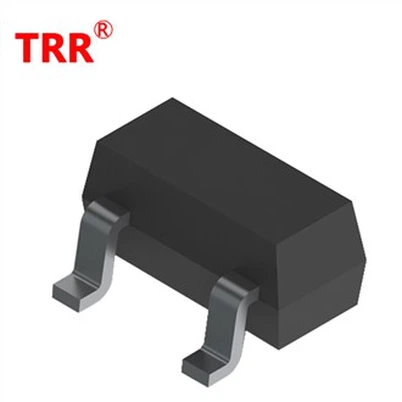
Packaging form: Select SOT-23, DO-214AC and other packaging options based on PCB space and heat dissipation requirements.
2. Layout optimization
Approaching the protection point: The diode should be as close as possible to the protected circuit to reduce parasitic inductance.
Ground plane treatment: Ensure that the ground pin of the diode is well connected to the ground plane to reduce the ground bounce effect.
Heat dissipation design: In high current applications, it is necessary to reduce the temperature of the diode through heat sinks or PCB heat dissipation layers.
四, Maintenance and troubleshooting of diodes in power modules
1. Regular testing
Forward voltage drop of diode: Measure with a multimeter to determine if the diode is aging or damaged.
Reverse leakage current: High reverse leakage current may cause a decrease in the efficiency of the power module.
Thermal imaging detection: By observing the temperature of the diode through an infrared thermal imager, overheating issues are detected.
2. Troubleshooting
Reverse protection failure: Check whether the diode is broken down or open circuited.
Overvoltage protection failure: Confirm whether the TVS diode has been damaged by surge.
Abnormal reverse current: Check if the freewheeling diode is short circuited or open circuited.
3. Maintenance suggestions
Replace aging diodes: Regularly replace diodes that have exceeded their service life.
Optimize heat dissipation conditions: Clean the dust on the heat sink to ensure good ventilation.
Upgrade protection level: Choose diodes with higher protection levels based on the application environment.
五, Future Development Trends
1. New materials and processes
Silicon carbide (SiC) diodes: higher breakdown voltage and lower on resistance, suitable for high-power power modules.
Gallium Nitride (GaN) diodes: Ultra fast switching speed, reduced switching losses, and improved efficiency.
2. Integration and Intelligence
Integrated protection function power chip: Integrating diode array with control circuit to provide more flexible protection strategy.
Adaptive protection technology: combining sensors and algorithms to dynamically adjust the working parameters of diodes.
3. Green and environmentally friendly
Lead free packaging: Compliant with RoHS standards, reducing environmental impact.
Low power design: Develop ESD protection devices with ultra-low leakage current to extend the device's battery life.
https://www.trrsemicon.com/diode/smd-diode/bat54ws-sod-323.html