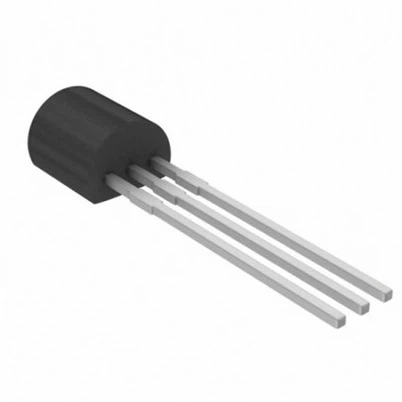
How to identify PNP transistors?
Leave a message
The basic structure of PNP transistor
PNP transistor is composed of two P-type semiconductor materials sandwiching an N-type semiconductor material, and its structure is "P-N-P. Compared to NPN transistors (N-P-N structure), PNP transistors have a polarity of "positive negative positive". The main components of PNP transistors include emitter (E), base (B), and collector (C). The emitter and collector are P-type semiconductor materials, while the base is N-type semiconductor material.
The internal current of PNP transistors is mainly generated by the movement of holes, rather than free electrons. When the base receives a small current, it controls the flow of current between the emitter and collector, causing the current to flow from the emitter to the collector. The base of a PNP transistor always maintains a negative potential relative to the emitter and collector, which is an important indicator of its operating characteristics.
Characteristics of PNP transistor
Carrier characteristics
The carriers of PNP transistors are mainly holes, which is in sharp contrast to the free electron carriers of NPN transistors. Holes move in P-type semiconductors, forming currents. In PNP transistors, the holes at the emitter are injected into the N-type region of the base, where they combine with electrons to form the base current. Subsequently, the remaining holes continue to move towards the collector, forming a collector current.
Polarity characteristics
The polarity of PNP transistors is "positive negative positive", which means that under normal circumstances, the emitter potential is the highest, the collector potential is the lowest, and the base potential is between the two and negative. This polarity characteristic makes the connection and usage of PNP transistors in circuits different from NPN transistors.
Working mode
PNP transistors play a crucial role in amplifying circuits by controlling the small current at the base to amplify the current between the emitter and collector. In addition, PNP transistors are commonly used as switches in embedded projects and are also used to generate PWM signals due to their fast switching characteristics. In applications such as motor control, PNP transistors are also used to control current and achieve precise current regulation.
Method for identifying PNP transistors
Observe the pin arrangement
The pin arrangement order of PNP transistors is usually "collector base emitter" (C-B-E), which is different from the "emitter base collector" (E-B-C) order of NPN transistors. By observing the pin arrangement of the transistor, it can be preliminarily determined whether it is PNP or NPN type.
Test with a multimeter
Using a multimeter is an effective method for identifying PNP transistors. Place the multimeter in the diode test mode. For PNP transistors, connect the red probe to the collector and the black probe to the base to obtain a forward diode conduction voltage drop (approximately 0.6 to 0.7 volts). Then move the black probe to the emitter, and a forward diode conduction voltage drop should also be obtained. If the test results are consistent with expectations, it is a PNP transistor.
Observe the circuit diagram
In circuit diagrams, the symbol for PNP transistors is usually an arrow pointing from the base to the collector, which is different from the symbol for NPN transistors where the arrow points to the base. By observing the symbols in the circuit diagram, the type of transistor can be determined.
Practical application testing
In practical circuits, applying a negative voltage to the base and observing whether the transistor is conducting is also a method of identifying PNP transistors. If the transistor conducts when a negative voltage is applied to the base, then it is PNP type.
https://www.trrsemicon.com/transistor/transistor-npn-s8050-0-8a.html