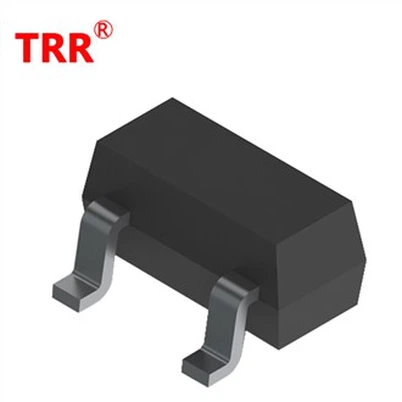
How do diodes work together in communication amplifiers?
Leave a message
一, The synergistic mechanism of diodes in signal processing
1. Limiting and clamping function
In communication amplifiers, diodes are commonly used to limit signal amplitude and prevent overload distortion. For example, in the intermediate frequency amplifier of an amplitude modulation receiver, a limiting circuit is formed by reverse parallel connection of two diodes. When the input signal exceeds the forward conduction voltage of the diode (about 0.7V), the diode conducts, clamping the signal amplitude within a safe range. This mechanism can effectively protect subsequent circuits from strong signal impact while maintaining signal integrity.
2. Rectification and detection functions
Diodes are commonly used in communication amplifiers to rectify and detect signals. For example, in an AC voltmeter in the audio range, the AC signal is converted into a DC signal through a bridge rectifier circuit. When the input signal is positive half cycle, the current flows through diode D1 to the meter; At the negative half cycle, the current flows through diode D2 to the meter. This structure eliminates the nonlinear error of the diode and ensures the linearity of the measurement.
3. Peak detection and holding
In the peak detection circuit, diodes and operational amplifiers work together to achieve accurate detection and maintenance of signal peaks. For example, when the input signal is positive, the operational amplifier and diode form a voltage follower, quickly charging the capacitor to the peak of the input signal; When the input signal decreases, the diode turns off and the capacitor maintains its peak voltage. This circuit is widely used in automatic gain control (AGC) systems, providing reference for subsequent gain adjustment.
二, The synergistic mechanism of diodes in circuit protection
1. Electrostatic discharge (ESD) protection
At the input of a communication amplifier, a pair of reverse series diodes are often connected in parallel for ESD protection. When the input signal is much lower than the forward conduction voltage of the diode, the diode does not function; When the input exceeds the forward conduction voltage of the diode, the diode conducts, embedding the input signal within the safe voltage range. This mechanism can effectively prevent damage to the amplifier input stage caused by electrostatic discharge.
2. Overvoltage protection
At the power supply end of communication amplifiers, diode arrays are often used for overvoltage protection. For example, by connecting multiple diodes in series, the maximum current required by the diodes in the array is limited within a safe range, and their maximum voltage drop is the sum of all forward voltage drops. This structure can provide a fixed known voltage within a limited range, protecting the circuit board from the effects of overvoltage.
3. Continuation flow and energy absorption
In inductive load circuits, diodes are commonly used for freewheeling and energy absorption. For example, in a switching power supply, when the switching transistor is turned off, the inductive load experiences a sudden drop in current and generates a reverse electromotive force. The freewheeling diode protects the switching circuit from damage by allowing the inductor to draw current, preventing the problem of charge carriers crossing with the inductor load.
三, Diode synergy mechanism in dynamic gain control
1. Application of PIN diode in AGC
PIN diodes have significant advantages in dynamic gain control due to their unique intrinsic layer structure. Its microwave conductivity is approximately proportional to the DC current, and its series resistance is small, resulting in low insertion loss. In AGC circuits, PIN diodes are often used as variable resistors in the inter stage coupling circuit of amplifiers. When the high-frequency signal increases, the bias current flowing through the PIN diode increases, its equivalent resistance decreases, and the shunt effect increases, thereby reducing the gain of the amplifier.
2. Forward control method and backward control method
In AGC systems, diodes are commonly used to implement forward and reverse control methods. The forward control method reduces the gain by changing the operating point current of the device to decrease its short-circuit current amplification factor β. The reverse control law reduces the gain by changing the operating point of the main amplifier, lowering its input impedance. Both methods achieve dynamic gain adjustment through the collaborative work of diodes and amplifiers.
3. Delay control circuit
In delayed AGC circuits, diodes work in conjunction with detectors and DC amplifiers to achieve delayed gain control. For example, the detection output voltage is applied to the positive terminal of the diode, and only when the detection voltage exceeds the reference voltage, the diode conducts, allowing the AGC control voltage to act on the amplifier. This mechanism can avoid the misoperation of the AGC system during small signals and improve the stability of the system.
四, Typical application scenarios and collaborative work cases
1. AGC system in amplitude modulation receiver
In amplitude modulation receivers, the AGC system achieves automatic gain adjustment through the coordinated operation of diodes and amplifiers. Both high-frequency amplifier and intermediate frequency amplifier are controllable gain amplifiers, and their gains are controlled by AGC control voltage. The output signal of the intermediate frequency amplifier is sent to the peak envelope detector of the main channel on one side, and is applied to another peak envelope detector on the other side. The DC voltage proportional to the carrier amplitude is demodulated and compared with the reference voltage, and then the AGC control voltage is obtained through the DC amplifier.
2. Optical front-end in fiber optic communication receivers
In fiber optic communication receivers, photodiodes and preamplifiers form the optical front-end, which converts and amplifies optical signals into electrical signals. Photodiodes convert light into photocurrent, while preamplifiers convert photocurrent into voltage and amplify the signal. During this process, diodes undertake the conversion function from photocurrent to voltage, working in conjunction with amplifiers to ensure accurate amplification and transmission of signals.
3. Noise suppression in TV antenna amplifiers
In TV antenna amplifiers, diodes and amplifiers work together to achieve noise suppression and signal enhancement. For example, by selecting low-noise input circuits and diode limiting circuits, the noise figure of the entire receiving system can be reduced, and the signal-to-noise ratio of television images and accompanying sound can be improved. The diode plays a role in signal limiting and noise suppression during this process, ensuring stable operation of the amplifier at high sensitivity.
https://www.trrsemicon.com/transistor/mosfet-transistor/transistor-si2310.html