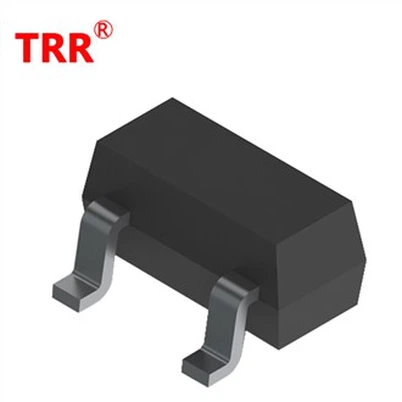
How do diodes assist in stabilizing voltage in medical equipment?
Leave a message
一, The core principle of voltage regulator diode: controllability of reverse breakdown region
Zener diode is a PN junction device manufactured by a special process, with its core characteristic being the constant voltage in the reverse breakdown region. Unlike ordinary diodes, when the reverse voltage reaches the critical value (breakdown voltage), the current of a voltage regulator diode increases sharply, but the voltage at both ends remains basically unchanged. This characteristic makes it an ideal voltage regulator component.
1. Analysis of Physical Mechanisms
PN junction breakdown: When the reverse voltage exceeds the breakdown voltage, the electric field strength inside the PN junction is sufficient to allow the charge carriers (electrons and holes) to obtain sufficient energy, causing collision ionization and forming a large number of charge carriers, resulting in a sudden increase in current.
Controllable breakdown: Through material doping and structural design, the breakdown of a voltage regulator diode is reversible. As long as the current does not exceed the rated value, the device can restore its original characteristics after removing the reverse voltage.
Voltage regulation range: The voltage regulation value (Vz) of a voltage regulator diode is usually between 2.4V and 200V, covering different voltage levels required by medical equipment.
2. Voltage regulator circuit design
Zener diodes are usually used in series with current limiting resistors to form a parallel type voltage regulator circuit. Its working principle is as follows:
When the voltage increases: If the input voltage (Usr) increases, the load voltage (Usc) also increases. The voltage regulator diode experiences reverse breakdown, causing a sharp increase in current and an increase in voltage drop across the current limiting resistor, thereby offsetting the rise in Usr and maintaining Usc stability.
When the voltage decreases: if Usr decreases, Usc decreases, the current of the voltage regulator diode decreases, the voltage drop of the current limiting resistor decreases, offsetting the decrease in Usr and maintaining Usc stability.
When the load changes: if the load current increases, the voltage drop of the current limiting resistor increases, and Usc decreases. The current of the voltage regulator diode decreases, the voltage drop of the current limiting resistor decreases, and the Usc remains stable.
Key parameters: The smaller the dynamic resistance (Rz), the larger the current limiting resistance (R), and the higher the stability of the output voltage. For example, in an electrocardiograph, using a 2CW52 voltage regulator diode (Vz=6.2V) in combination with a 100 Ω current limiting resistor can compress the input voltage fluctuation range from ± 20% to ± 1%, ensuring signal acquisition accuracy.
二, Typical application scenarios in medical equipment
1. Portable medical devices: balance low power consumption and high reliability
In devices such as blood glucose meters and portable ultrasound probes, Schottky diodes (such as BAT54S) have become the preferred choice for anti reverse connection and voltage stabilization due to their low forward voltage drop (0.15-0.45V) and fast switching characteristics. For example:
Anti reverse connection protection: Connect a Schottky diode in parallel at the power input terminal. When the power polarity is reversed, the diode will reverse and cut off, blocking the current path and preventing internal circuit from burning out.
Power path selection: In a dual battery power supply system, the main and backup power sources are automatically switched through diodes to ensure continuous power supply. For example, a certain model of portable monitor adopts dual BAT54S parallel connection to achieve power redundancy design, which can still maintain operation in case of single battery failure.
2. High power medical equipment: impact resistance and stability optimization
In devices such as defibrillators and high-frequency electric knives, it is necessary to deal with transient high current surges. At this point, fast recovery diodes (FRDs) and silicon carbide (SiC) diodes become key components:
Defibrillator charging circuit: MBR30200PT Schottky module (30A/200V) is used, with a reverse recovery time (trr) of less than 5ns, which can prevent voltage spikes caused by diode switch delay during charging and protect high-voltage capacitors from overvoltage breakdown.
High frequency electric knife output stage: using C6D10065A SiC Schottky diode (100A/650V), its low forward voltage drop (1.5V) and high temperature resistance characteristics (175 ℃ junction temperature) ensure that the diode's own power consumption is reduced by 60% during 1MHz high-frequency cutting, while avoiding performance degradation caused by overheating.
3. Precision medical instruments: signal integrity and anti-interference design
In devices such as electrocardiographs and electroencephalographs, the acquisition of weak bioelectric signals requires strict suppression of noise. At this point, the collaborative design of photodiodes and protective diodes becomes crucial:
Optoelectronic coupling isolation: In the signal input channel, a 6N137 optocoupler is used to achieve electrical isolation and block common mode interference through the photoelectric conversion of diodes. For example, a certain model of electroencephalograph increases the input impedance to 10M Ω through photoelectric coupling, and the common mode rejection ratio (CMRR) reaches 120dB.
ESD protection: At the sensor interface, parallel ESD5D150TA Schottky diode with low leakage current (<0.1 μ A) and high reverse withstand voltage (150V) can effectively discharge the transient current generated by electrostatic discharge (ESD) and prevent sensor damage.
三, Innovative voltage stabilization solution: Collaborative design of diodes and other components
1. Composite protection circuit: diode+TVS diode
In the image transmission module of medical endoscopes, a composite protection scheme of "Schottky diode+TVS diode" is adopted to prevent transient overvoltage caused by lightning strikes or static electricity:
Schottky diode: parallel connected to the power input terminal, providing daily anti reverse protection.
TVS diode: series connected to the signal line, its ultra fast response time (<1ps) and low clamping voltage (such as SMAJ5.0A's clamping voltage of 7.8V) can limit overvoltage within a safe range in nanoseconds, protecting the downstream ADC chip from damage.
2. Self recovery protection: diode+PTC thermistor
In the charging circuit of wearable medical devices (such as smart bracelets), a self recovery protection scheme of "Schottky diode+PTC thermistor" is adopted:
Schottky diode: prevents battery reverse connection while utilizing its low voltage drop characteristics to reduce charging losses.
PTC thermistor: series connected to the charging path, when the current exceeds the threshold, the PTC resistance value sharply increases, limiting the current; After troubleshooting, PTC automatically returns to a low resistance state without the need to replace components.
3. Ideal diode solution: integration and intelligence
With the popularity of wide bandgap materials, integrated ideal diodes (such as LM66100DCK) have become the preferred choice for high-end medical equipment. Its working principle is as follows:
Power adapter supply: Disconnect TYPE-C output through internal PMOS cutoff.
TYPE-C power supply: Output 5V voltage through internal PMOS conduction.
Battery powered: When both point A and point C have a potential of 0V, the internal PMOS conducts and the battery supplies power to the load.
This solution has the advantages of comprehensive protection, low pressure reduction, low internal resistance, and low heat generation, and is widely used in portable ultrasound, endoscope and other equipment.