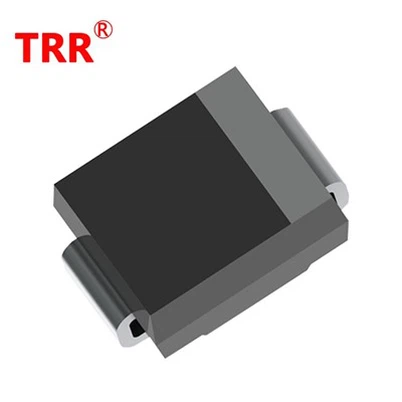
Application skills of diodes in efficient power conversion
Leave a message
1, The basic role of diodes in power conversion
The main functions of diodes in power conversion include rectification, clamping, protection, and switching. Rectification is the process of converting alternating current into direct current, which is one of the most fundamental applications of diodes. Clamping is the use of the conduction voltage characteristics of diodes to limit the voltage in the circuit within a certain range, preventing overvoltage damage. The protection function is mainly reflected in preventing the impact of reverse current and transient voltage on the circuit. The switch function utilizes the fast conduction and cutoff characteristics of diodes to achieve rapid switching of circuits.
2, Choose the appropriate diode type
Choosing the appropriate diode type is crucial in efficient power conversion. Here are some key considerations:
Forward voltage drop (Vf): Forward voltage drop is the voltage loss when a diode is conducting, which directly affects the power conversion efficiency. Choosing diodes with low forward voltage drop, such as Schottky diodes, can significantly reduce energy loss and improve conversion efficiency.
Reverse recovery time (Trr): In high-frequency applications such as switching power supplies, the reverse recovery time of diodes has a significant impact on conversion efficiency. A shorter reverse recovery time means faster switching speed, thereby reducing energy loss during the switching process.
Maximum reverse voltage (Vrm): Select the appropriate maximum reverse voltage value based on the operating voltage of the power conversion circuit. Excessive reverse voltage may cause diode breakdown and damage, while excessively low values may limit the application range of the circuit.
Thermal characteristics: In high-power applications, the heat dissipation problem of diodes cannot be ignored. Choosing diodes with good thermal characteristics, such as packages with heat sinks, can ensure stable operation under high load conditions.
3, Optimize circuit design to improve conversion efficiency
Adopting synchronous rectification technology: In low voltage and high current applications, traditional Schottky diode rectification may result in significant forward voltage drop losses. At this point, synchronous rectification technology can be used to replace diodes with MOSFETs for rectification, significantly reducing energy loss and improving conversion efficiency.
Optimize the operating point of the diode: By accurately calculating the operating current and voltage of the diode, ensure that it operates at its optimal state. Prevent diodes from operating under extreme conditions for extended periods of time to reduce energy loss and prolong their lifespan.
Reduce parasitic parameters: In power conversion circuits, parasitic inductance, capacitance, and resistance parameters can affect the switching speed and energy loss of diodes. By optimizing circuit layout and wiring to reduce parasitic parameters, the switching speed and conversion efficiency of diodes can be improved.
Adopting soft switching technology: In high-frequency switching power supplies, hard switching will result in significant switching losses. The use of soft switching technologies such as zero voltage switching (ZVS) and zero current switching (ZCS) can significantly reduce energy loss during the switching process and improve conversion efficiency.
4, Practical application cases and skill sharing
Application in DC-DC converters: In DC-DC converters, diodes are typically used for rectification and clamp protection. By selecting appropriate diode types and optimizing circuit design, the efficiency and stability of the converter can be significantly improved. For example, in buck converters, the use of synchronous rectification technology can significantly reduce the voltage loss at the output terminal and improve conversion efficiency.
Application in LED driver circuits: In LED driver circuits, diodes are commonly used to protect LEDs from the impact of reverse voltage and transient voltage. Choosing diodes with fast reverse recovery time and low forward voltage drop can ensure stable LED emission and extend its service life.
Application in solar inverters: In solar inverters, diodes are used for rectification and anti backflow protection. By optimizing the selection of diodes and circuit design, the conversion efficiency and reliability of inverters can be improved. For example, using high-efficiency Schottky diodes for rectification can significantly reduce energy loss and improve the output power of the inverter.
https://www.trrsemicon.com/diode/dip-diode/silicon-rectifier-diodes-1n4007.html