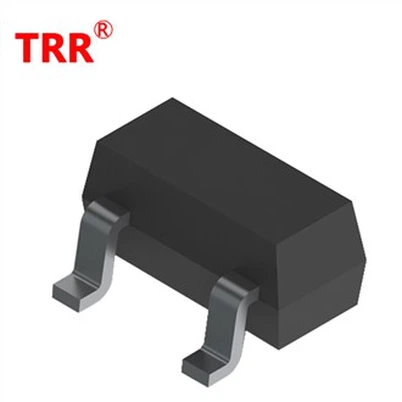
Application of diodes in battery protection circuits
Leave a message
1, Overview of Battery Protection Circuit
Battery protection circuit is a circuit system specifically designed for monitoring and protecting battery packs. Its main task is to monitor key parameters such as voltage, current, and temperature of the battery, and take timely measures to protect the battery from damage in case of abnormal conditions such as overcharging, overdischarging, short circuit, or overheating. The battery protection circuit usually consists of a voltage detection module, a current detection module, a temperature detection module, a control module, and a protection execution module.
2, Basic principles and characteristics of diodes
A diode is an electronic component with unidirectional conductivity, composed of a PN structure formed by a P-type semiconductor and an N-type semiconductor. When a voltage higher than the negative electrode (cathode) is applied to the positive electrode (anode) of a diode, the diode conducts, allowing current to flow from the positive electrode to the negative electrode; When the positive voltage of the diode is lower than the negative voltage, the diode cuts off and the current hardly flows. This unidirectional conductivity enables diodes to serve multiple functions in circuits, including rectification, voltage regulation, switching, and protection.
3, Application of diodes in battery protection circuits
Prevent battery overcharging
During the battery charging process, if the charging current is too high or the charging time is too long, it may cause overcharging of the battery, leading to serious problems such as internal short circuits, electrolyte decomposition, gas generation, and battery expansion. To prevent battery overcharging, battery protection circuits usually use overcharge protection circuits. Among them, the diode, as one of the key components, can cut off the charging current in a timely manner when the battery voltage reaches the preset upper limit, thereby preventing overcharging of the battery. This protective effect can significantly extend the service life of the battery and avoid safety accidents caused by overcharging.
Prevent battery over discharge
During the discharge process of a battery, if the discharge current is too high or the discharge time is too long, it may lead to over discharge of the battery, which in turn can cause serious problems such as damage to the internal crystal structure of the battery, detachment of active substances, and decreased battery performance. To prevent battery over discharge, battery protection circuits usually use over discharge protection circuits. Diodes also play an important role in this process. When the battery voltage drops to the preset lower limit, the diode will cut off, cutting off the discharge current to protect the battery from damage. This protective effect ensures that the battery operates within a safe voltage range and avoids premature disposal due to overdischarging.
Provide reverse voltage protection
During the use of the battery, if there are abnormal situations when the battery pack is connected to the external circuit, such as reverse connection or external circuit short circuit, it may cause the battery pack to be impacted by reverse voltage. This reverse voltage may cause serious damage to the battery pack and even lead to safety accidents such as battery explosions. To address this issue, battery protection circuits typically connect a diode in parallel at the input of the battery pack. When a reverse voltage appears in the external circuit, the diode will reverse breakdown and conduct, releasing the reverse voltage to the ground to protect the battery pack from damage. This reverse voltage protection can significantly improve the safety and reliability of the battery pack.
Transient voltage suppression
During the process of battery charging and discharging, transient overvoltage may occur in the battery voltage due to factors such as power fluctuations, sudden load changes, or external interference. This transient overvoltage may cause damage to the battery pack and its surrounding circuits. To suppress this transient overvoltage, battery protection circuits typically use transient voltage suppression (TVS) diodes. TVS diodes have the characteristics of fast response speed, low breakdown voltage, and low power loss. They can quickly conduct when transient overvoltage occurs, absorb and discharge the overvoltage to the ground, thereby protecting the battery pack and its surrounding circuits from damage.
4, Diode selection and optimization design
The selection and optimization design of diodes are crucial for improving the performance and stability of battery protection circuits. On the one hand, it is necessary to select diodes with appropriate breakdown voltage, reverse leakage current, and forward conduction voltage drop characteristics to ensure their normal operation in battery protection circuits. On the other hand, it is also necessary to optimize the design of diodes, such as adopting low-power, high reliability packaging forms, improving the heat dissipation performance of diodes, etc., in order to further improve the efficiency and safety of battery protection circuits.
https://www.trrsemicon.com/diode/smd-diode/sot-23-zener-diode-bzx84c6v8.html